


Bruce Crawford
August 2021 Plant of the Month – When A Petunia is not a Petunia
July 2021 Plant of the Month – Culver’s Root
The Culver’s Root Fan Club
Why are certain plants popular with gardeners and others not? It is a pattern that I have always found interesting. Currently, one of the popular trends that will hopefully become the norm is adding native plants to the garden. These plants are beneficial for sustaining both the adult and the larval forms of our local insect populations. In addition, plants that provide color, height and texture during the summer months have also become very popular. Culver’s Root, botanically known as Veronicastrum virginicum has all of these virtues, yet for some mysterious reason, it has yet to gain recognition within the gardening community.
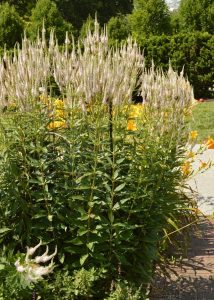 Culver’s Root is one of approximately 20 species of Veronicastrum found throughout North America, Europe and Asia. A member of the Plantain Family or Plantaginaeae, this species is native to open forests, meadows, grassy mountain slopes and prairies from Ontario south to Georgia and Louisiana. It was originally collected by the Reverend and Naturalist John Banister (1654-1692) soon after he moved to Virginia in 1679 and was initially named Veronica virginica in 1753 by the Swedish botanist Carl Linnaeus (1707-1778). It was not until 1917 that the Herbarium curator and drug inspector for Park, Davis and Company, Oliver Atkins Farwell (1867-1944) assigned the proper genus name. Interestingly, the name Veronicastrum was not new to the world of plants, as it was originally penned in 1759 by the German botanist and surgeon Philipp Conrad Fabricius (1714-1774). Obviously, it incorporates the genus name of Veronica, which was initially crafted by Linnaeus in 1753. According to Christian faith, St. Veronica gave her veil to Jesus to wipe the sweat from his face as he carried the cross to Calvary. Evidently, some species of Veronica have markings on the leaf that resemble St. Veronica’s veil. Astrum is Latin for Star, indicating that Veronicastrum resembles or shines like Veronica! The species epithet honors the location of its discovery by John Banister. The common name pays tribute to Dr. Culver, a physician in the early Eighteenth Century who supposedly recommended the root for medicinal uses. Interestingly, there does not appear to be a record of Dr. Culver’s life, indicating the use of the root by the doctor may be more of a myth than fact!
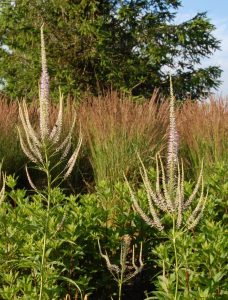 The apparent absence of Veronicastrum in many Gardens is by no means due to its lack of physical stature, since the plant typically reaches 5-7’ tall with a spread of 2-3’. The stout stems have whorls of 5, 6 or 7 leaves at nodes every 6-8” along the stem. Each leaf is upwards of 7” long! This leaf arrangement provides numerous horizontal lines in the Garden (as seen above right with Veronicastrum virginicum ‘Roseum’), which can be successfully used to pull the horizontal lines of architecture out into the Garden. If the plants are massed in a meadow-like setting, the whirls of foliage creates an almost psychedelic effect on the eyes! Come late June and throughout July, the tips of the stems yield 6-12” long spike-like racemes of white or bluish white flowers. The central spike typically has one to several whirls of smaller, subtending flower spikes that appear from the lower leaf nodes, as seen at left. These lower spikes help to enhance the display while providing a royal ‘crown-like’ appearance. The individual flowers appear in vertical rows along the stems. Each outwardly oriented flower is cup shaped, consisting of 4 fused petals. They are approximately ⅛” in diameter by ¼” long. The brown tipped anthers extend an additional ¼” beyond the flower, resulting in an airy or lacey effect for the flower spikes as seen below. The stems can be pinched back in mid to late May if a more compact plant is desired. Pinching the plants also delays flowering time by several weeks, but otherwise does not alter the overall appearance. If a light lavender flowered form is desired, consider ‘Lavender Towers’ (pictured above) or ‘Fascination’. ‘Cupid’ is a new selection whose flowers are a much darker lavender with blue highlights. Certainly one to look for in the years to come!
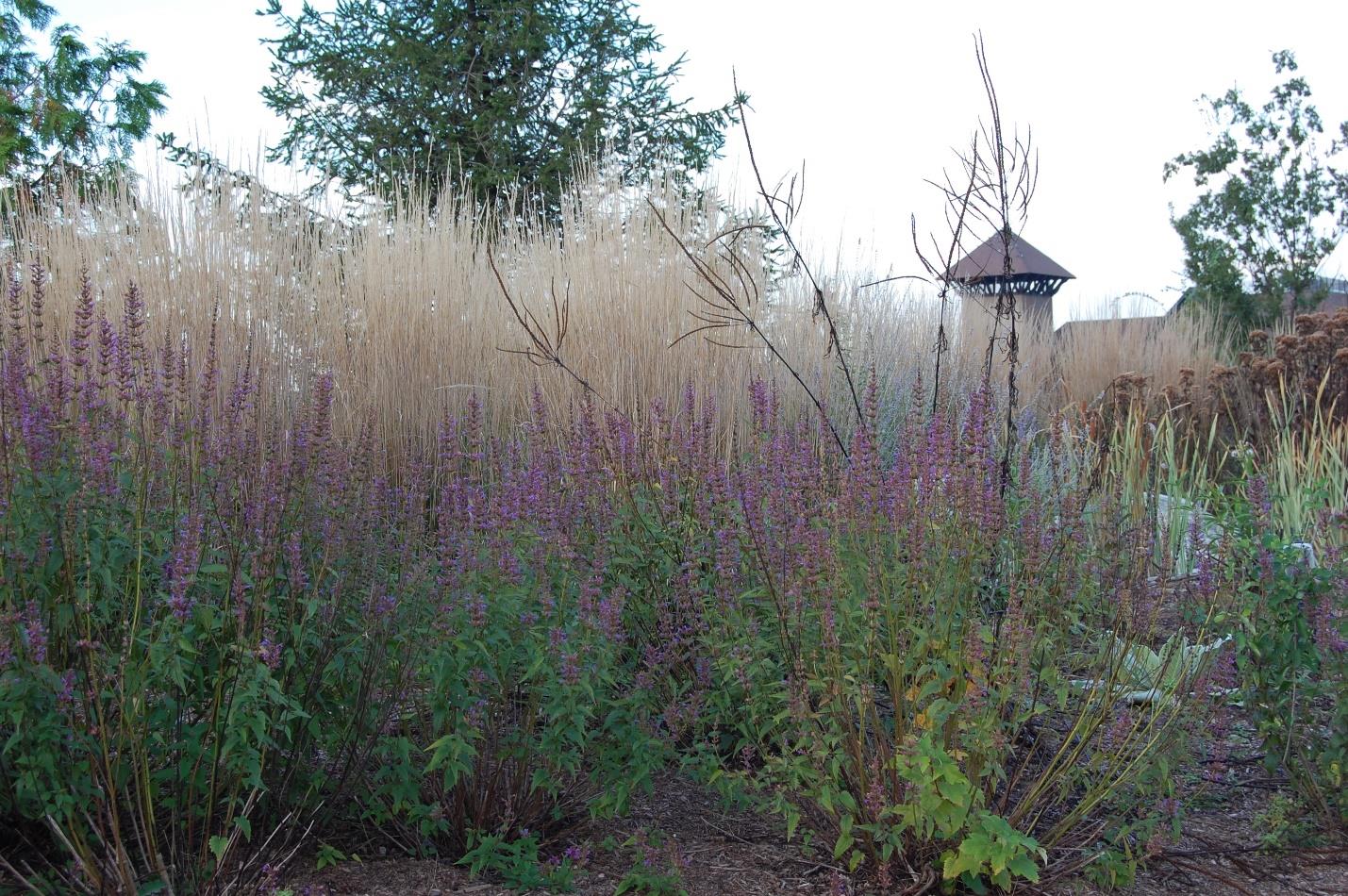
Culver’s Root needs full sun and soils that do not dry out in order for it to thrive its best. With its tall stature, it is traditionally placed towards the back of a border. However, since it possesses a very upright or columnar habit, it can also be placed towards the front of a border, where it enhances the visual depth to a border; the act of having to look past or around the plant to view the balance of the border makes the garden appear larger. 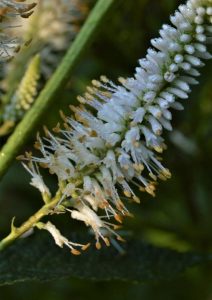 It also looks fantastic worked in with some of the mid-sized ornamental grasses, such as Karl Foerster Feather Reed Grass (Calamagrostis x acutiflora ‘Karl Foerster’), since the flowers appear to float above the top of the grasses. Plus, the upright, spiky composition of the Culver’s Root is repeated with the Feather Reed Grass, creating a very dynamic, vertical composition. You might consider working Culver’s Root with Rodger’s Bottlebrush Buckeye (Aesculus parviflora var. serotina ‘Rodgers’) or Summersweet (Clethra alnifolia). The image at left features the straight species of Bottlebrush Buckeye in the backdrop, which blooms several weeks earlier. Rodger’s Buckeye and Summersweet are July blooming shrubs with long upright racemes of white flowers, echoing those of Veronicastrum.
 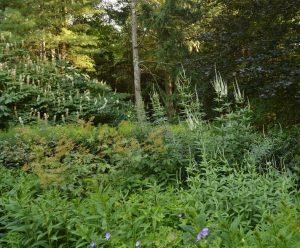 The repetition of the flower shape and color brings great unity and cohesion to the Garden! Culver’s Root remains attractive well into winter, since the frosted stems add attractive forms to the fall and winter Garden composition, as seen below in October with Agastache ‘Purple Haze’ and Calamagrostis. I have yet to see the plant self-sow when left standing through winter and subsequently cut the plants back in early to mid-March.
For a plant that has a long history with gardeners, starting with John Banister in the late 1600’s, it seems odd for this plant to not be a garden favorite. With the regal crown-like floral display combined with its many other attributes, it only seems natural for this plant to have far better recognition in the gardening community. Perhaps it’s time to start the Culver’s Root fan club?
Bruce Crawford
State Program Leader for Home and Public Horticulture (NJAES)
June 2021 Plant of the Month – Mountain Mint
Mountain Mint – Truly, a Gardeners Mint
Mint is a plant that conjures up a multitude of thoughts and emotions among gardeners. Typically, our first thought is of a plant with wonderfully fragrant foliage that happens to combine well with Ice Tea and Mint Juleps! Unfortunately, this is matched with an equally unsettling vision of a plant that knows no boundaries and will rapidly spread throughout your garden! True mints are found within the genus Mentha, and their aggressively spreading nature makes them problematic in an ornamental garden. However, there are other plants in the mint family or Lamiaceae that display a far greater degree of garden refinement and manners. Mountain Mint, botanically known as Pycnanthemum muticum, is one such member of the Lamiaceae and it defies my imagination as to why this plant is not more popular among gardeners.
Mountain Mint is certainly not a new plant to the world of horticulture. It was first discovered by the French botanist Andre Michaux (1746-1802) in 1790, when he found masses of the plant growing in Pennsylvania! Michaux initially named and described the plant as Brachystemum muticum, which was published posthumously in 1803 in his work Flora Boreali-Americana. Interestingly, in the same book he described a new genus named Pycnanthemum! Both names are from the Greek to describe the flower structure; Brachys means short and Stelma means column while Pyknos means dense and Anthos means flower. It only took a few years for the French botanist and mycologist Christiaan Hendrik Persoon (1761-1836) to assign the proper genus name in 1806. The species epithet comes from the Latin Muticus for blunt, perhaps a reference to the dome-shaped or blunt appearance of the apical flowers. Although the common name is Mountain Mint, it actually does not grow in alpine regions, but rather in open, moist fields and forest edges, which can be located along the lower elevations of a mountain.
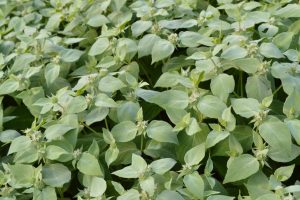 Personally, I was not introduced to this plant until 2010 while touring Central Park. It appeared periodically throughout the park as a 2-3’ tall mass of shimmering silver along the edge of woodlands and ponds. Although the day was cloudy and it was mostly growing beneath a canopy of tall trees, the plant gave the impression of sunlight cutting through openings in the branches and illuminating the forest floor beneath. The gentleman leading the tour mentioned how these masses of Mountain Mint had been installed in an effort to reduce weeds. Naturally, I thought it was another invasive mint and was about to dismiss the plant when he noted it was merely a dense, ‘weed-suppressing’ plant and not invasive. A weed suppressing, non-invasive mint – my interest in this plant began to grow!
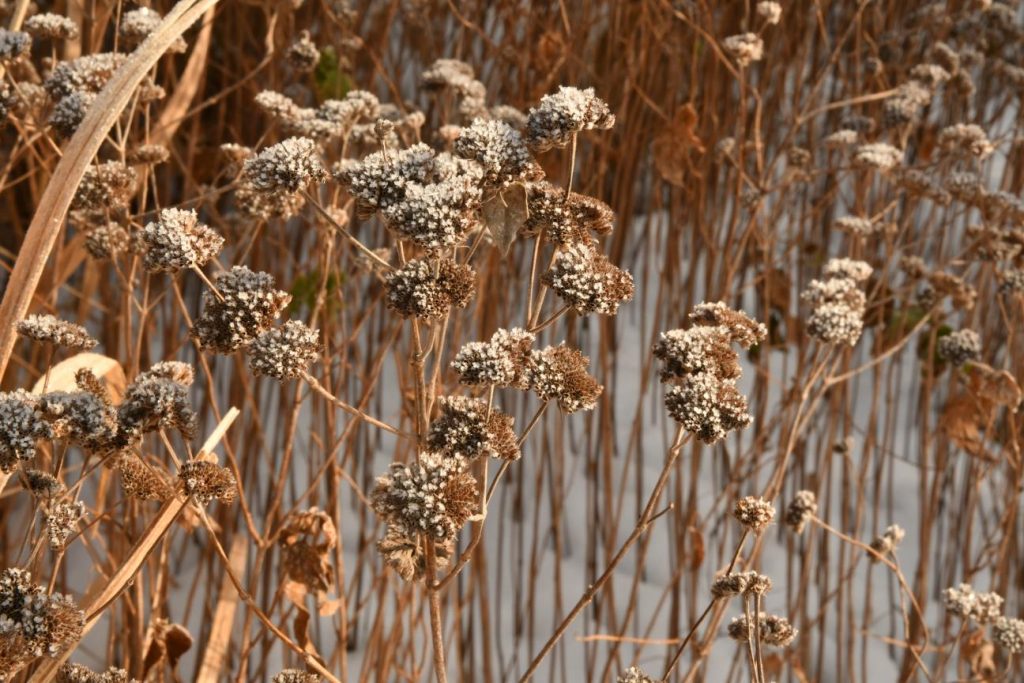
The shimmering, silvery effect of the plant was not the result of a true flower petal, but rather a pair of silver colored bracts or modified leaves that subtend the terminal boss of small white to light pink flowers, as seen in the image above. Much like Poinsettias and our native Flowering Dogwood, the actual flowers are very small and the primary impact is created by these bracts. For Pycnanthemum, they provide a beautiful ornamental effect for over 3 months! The flowers themselves are roughly ⅛” long, white with pink markings and are densely arranged in a ½” diameter compressed flower structure called a cyme. It is this dense arrangement of flowers that sparked the crafting of the two initial genus names. The flowers open over a 3 month period beginning in June and are a great source of nectar for bees, beneficial wasps, moths and butterflies! In fact, it is rare that the plants are not a flurry of activity when in bloom. Come winter, the clusters of dried seed capsules atop the stems have a nice winter presence, especially with a heavy December frost as pictured at the end. My interest in this plant grew even further!
 The lance-shaped, dark green foliage, measures 2-2 ½ inches long and is much like a typical mint, the foliage is very aromatic when rubbed. Tightly clad to the square stems by only a short petiole, the foliage contains pulegone, an oil with an aroma reminiscent of spearmint that is very effective at repelling mosquitoes when rubbed on the skin. This aroma is also effective at eliminating deer browse!
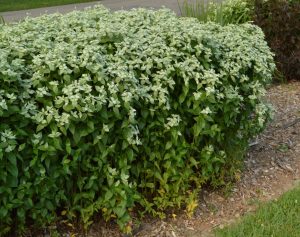
Mountain Mint is a great plant for working into the Garden. It looks great paired with the silver foliage of Lamb’s Ear (Stachys lanata) and it is great at brightening the darker foliage of deep purple leaved plants like Purple Leaved Smoketree (such as Cotinus coggygria ‘Velvet Cloak’). I have found that the plants and stems have a very vertical appearance that can make a design look awkward when planted along the edge of a planting (as pictured at left) since the transition to the ground plane is very abrupt. It is best to have a lower growing plant or a mounding plant placed at the front of Mountain Mint to provide a more gentle transition to turf, a walkway or simply the ground plain. Plants grow well in full sun as well as light shade, providing that the soil does not become excessively dry for prolonged periods. The plants are adaptable to various soil types and pH; they are typically found growing on alkaline soils in the wild, but are tolerant of acidic soils and are surprisingly tolerant of moister soils along pond edges. The soils simply cannot remain waterlogged with ponding water for extended periods of time. The rhizomes do spread about 4-6” per year, but they are easily cut with a garden spade and the shallow stems are easily extracted, even if they have started to grow into a neighboring plant. This is a practice that should typically be done every other year.
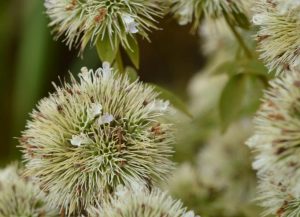 If more of a clump forming species is of interest consider Pycnanthemum flexuosum or Appalachian Mint. Originally named Origanum flexuosum in 1788 by the American botanist Thomas Walter (1740-1789), its name was altered a century later in 1888 by Nathaniel Lord Britton (1859-1934). Britton was the American botanist who went on to cofound the New York Botanical Garden! The species epithet means pliant and is probably a reference to the flexible stems. Growing 2-3’ tall and roughly as wide, the dense root system is great for soil stabilization and since the foliage is also aromatic, it too is resistant to deer browse. The flower clusters or cymes lack the silvery bracts of its cousin, but they are much larger, typically around 1 ½” in diameter (as pictured at right). The purple flecked, white flowers remain rather diminutive, with the ¼” long tubular flowers appearing for nearly 2 months throughout the summer. Like its cousin, they are also exceptionally attractive to pollinators. Unlike its cousin, each flower has a more pronounced calyx or leafy base that initially serves to protect the flower bud and then physically support the tubular flower. Once the flower fades and drops away, each of the 5 off-white sepals that compose the calyx have a long bristly spur at the tip, giving the flower head a Sputnik or fuzzy appearance. The ultimate effect produces a bit more drama to the flower and the Garden, which I found very ornamental! This species has similar cultural requirements as its cousin and both are hardy throughout NJ, easily enduring a zone 5 winter and the summer’s heat.
Interestingly, both species began their affiliation with horticulture under different and distantly related genera within the mint family, only to find out they were in fact closely related cousins. My interest and admiration for what these plants can provide for the Garden only continues to grow as I continue to find new ways to incorporate these plants in designs! Granted, no plant is perfect, since neither of these Mints should be eaten or used as a garnish in a glass of Ice Tea or a Mint Julep! However, if you have been searching for a deer resistant native plant that is friendly to pollinators, suppresses weeds and works well others, here are 2 mints that you surely want to add to your list of great garden worthy plants!
Bruce Crawford
State Program Leader in Home and Public Horticulture, NJAES
May 2021 Plant of the Month – Asimina
One of the positive developments from the pandemic is the renewed interest in gardening and in particular, growing food. I have always been astonished at how many children do not know how their food is produced, other than it magically appears on grocery store shelves. Obviously, their parents did not share a passion for growing food and hopefully, that will continue to improve once the pandemic is behind us. Some fruits are not only tasty and nutritious, but have an attractive ornamental appeal. For years I have been touting the beauty and benefits of Pawpaw Trees, botanically called Asimina triloba. Perhaps now, this tree’s time has finally arrived!
Pawpaw is a member of the Annonaceae or Custard Apple Family, containing upwards of 108 different genera and 2,400 species that are principally located in tropical and subtropical regions of the world. Asimina triloba is one of 12 species, all native to North America and is the most Northern and cold hardy species of the family, distributed from Georgia north to Ontario and west to Arkansas and Missouri. It typically appears in moist, well-drained areas along shaded streams, forested lowlands and wooded slopes. Pawpaw was initially named Annona triloba in 1753 by the Swedish Botanist Carl Linnaeus (1707-1778). 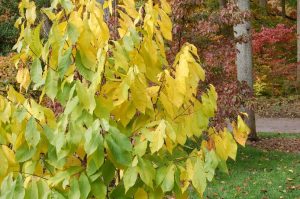 The genus is still in existence with around 166 species and was derived from the Taíno word Anón for fruit. Taíno was the name of the culture of indigenous people in the Caribbean prior to the arrival of the Spanish. The genus name of Asimina was penned by the French Botanist and Naturalist Michel Adamson (1727-1806) in 1763. The word was adopted from Assimin or Rassimin, as the tree was so named by the Native American Algonquian Indians. It was not until 1817 that the French Botanist Michel Felix Dunal (1780-1856) properly described the tree as Asimina triloba, although the tree continued to undergo various renditions until 1886 when it was conclusively decided by the American Botanist,
  Asa Gray (1810-1888) that Dunal was correct. The species epithet means 3 lobes and describes the double whorl of 3 petals that comprise the flower (see images below). The common name of Pawpaw is believed to have come from the Spanish Papaya due to the similarity of the fruit shape, size and taste.
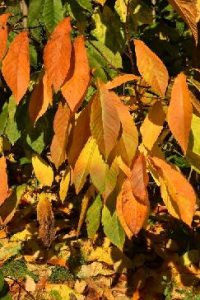
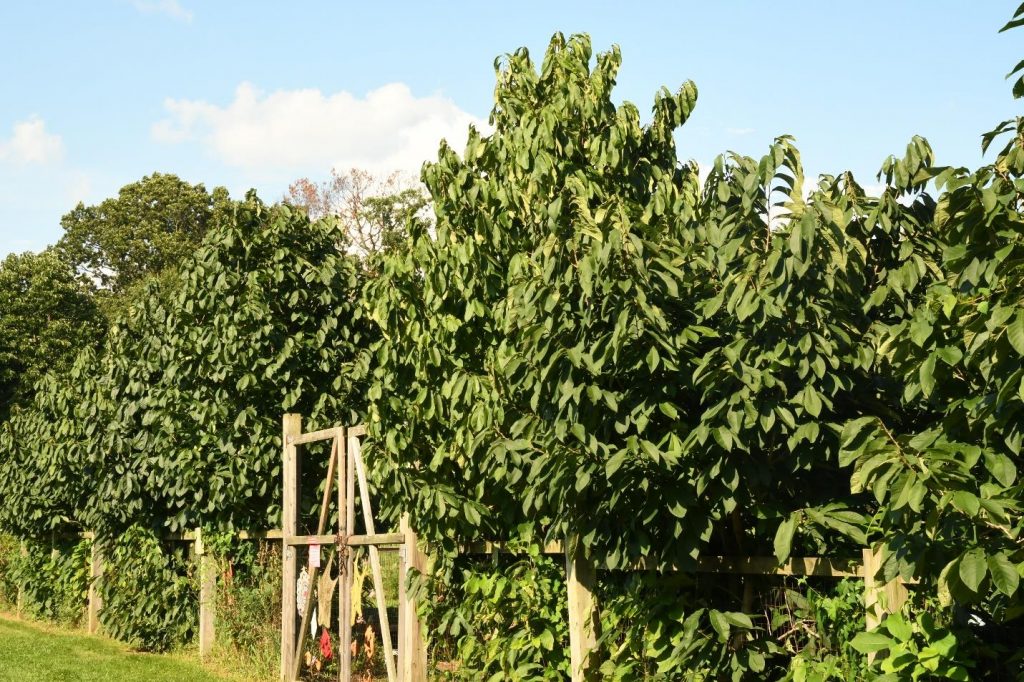
Although Pawpaw is hardy to zone 5, its appearance certainly reflects the tropical and subtropical regions inhabited by the remainder of the Custard Apple Family. The oblong foliage is 6-12” long with a pronounced outward and gently drooping display. The leaves are arranged alternately along the stems and come autumn, develop an attractive yellow fall color in shade (picture above), although it can blend with orange when grown in full sun (pictured at left). Asimina is an understory tree, typically growing to 15-20’ in height, although heights of 30’ are not uncommon when conditions are ideal. Although it grows in shaded locations in the wild, it adapts very well to full sun in the home garden, provided it is given a little protection from the afternoon sun for the first year or so. The 1-2” diameter flowers are bell-shaped or campanulate, with the dangling flowers beginning to open along the leafless stems in mid-April. 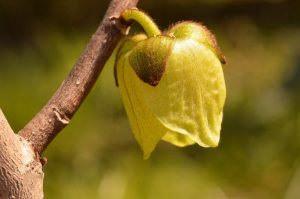 The flower buds open sequentially from the inner reaches outward, which is a great adaption in case of an unexpected late spring frost; the closed flower buds are not impacted by the chill and subsequently continue to open and ultimately bear fruit! The flowers are initially a pale green on opening as pictured above, but gradually change to a deep ‘meaty’ red at maturity. The flowers consist of an outer whorl of 3 lightly pubescent sepals or modified leaves that are also initially green before developing dark red highlights with age. The sepals and flower stem are lightly pubescent and are located at the top of the flowers once open as seen above. The six petals are arranged in two distinct tiers of three, with a larger outer whorl and a puckered inner whorl (as seen at left).
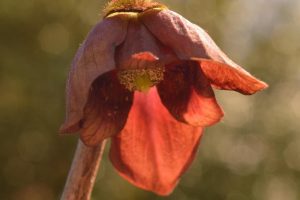 The flowers have a slightly fetid odor, which in combination with the deep red color of the flower provides the clues for which creatures serve as pollinators – namely flies and beetles! Not to worry, I have never seen flies hovering around the trees and there is always good fruit set. It is important to plant several different clonal selections of Pawpaw, since the trees are not self-fertile and require at least two genetically different plants for pollination. The species exhibit what botanist call protogynous dichogamy, whereby the female stigma and the male anthers mature at different times, preventing self-pollination and inbreeding depression. My experience has been pruning the plants into a somewhat planar or two dimensional configuration, combined with removal of the root suckers helps to enhance flowering and fruiting.
Pawpaws produce the largest edible fruit in North America (pictured below), ultimately reaching lengths of 3-6” and weights upwards of 5-16 oz.! When ripe, the fruit changes from green to varying shades of light yellow, with a sweetly aromatic fragrance and a slight softness to the touch. The fruit’s taste also has tropical overtones with accents of mango and pineapple, yet with the texture of ripe banana or custard. The ripe flesh is best eaten with a spoon or made into ice cream, 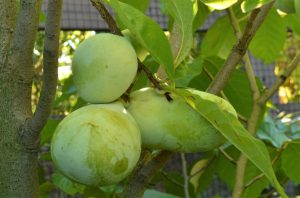 a smoothie or used in baking. Using a spoon is also handy since the fruits have two rows of large dark brown seeds that are challenging to eat around! The fruit has to be picked when ripe since, at least in my experience, they fail to ripen if picked too early. They also have a very short shelf life of only a few days, although the pulp can be frozen for up to a year if properly processed. Aside from sweet tasting, the fruit is also very nutritious, containing healthy amounts of Vitamin C, Magnesium, Iron, Copper and Manganese. They are also a good source of Potassium and antioxidants.
Of course, the plant did not develop these delicious fruits in conjunction with the evolution of Homo sapiens, since fossil records of Asimina date back 23 to 54 million years ago, long before the appearance of our ancestors. It is known that fruit eating Megafauna or mammals over 100 lbs. such as Mastodons, once roamed North America and were responsible for not only consuming the fruit, no doubt in one ill-mannered bite, but spreading the seed and slowly enlarging its native territory. With the loss of many of these animals between 12,000 and 13,000 years ago, the reproduction and distribution of many plants was also impacted. One rather annoying characteristic of Pawpaw is its strong tendency to sucker from the rootstock and create colonies. Although bothersome in the Garden, this trait may have allowed the plant to endure; since there was no longer a vector for seed distribution, the production of new stems allowed a colony to endure as the older trunks failed! As the Native American Indians slowly spread throughout North America, they in turn took over the task of the megafauna in spreading and planting the seed! Another trait that is both beneficial and problematic is the lack of insects or animals that eat the foliage or stems. Rarely is deer browse evident. Initially, this may sound beneficial, but like many members of the Annonaceae Family, Asimina contains acetogenins that function as a neurotoxin. These compounds are most concentrated in leaves, young stems and unripened fruit, which explains the lack of deer browse. It is also present in ripened fruits. Many cultures throughout the tropics create a tea from the leaves of plants from the Annonaceae family, which supposedly acts as a sedative. Over the course of a lifetime, this consumption creates an atypical form of Parkinson’s disease. The point being that one should not overindulge in the fruits either, but rather practice moderation!
Pawpaw is a plant that is entrenched in American culture. According to the writings of Lewis and Clark in September of 1806, Pawpaw fruits sustained their expedition for several days after their supplies dwindled and both George Washington and Thomas Jefferson were great fans and grew trees in their garden. It is certainly not without its faults. However, it is a great plant for people who are exploring fruit and vegetable gardening for the first time or well-seasoned gardeners who are interesting in exploring new food options. Without doubt, it is a delicious and ornamental tree for your garden!
Bruce Crawford
State Program Leader in Home and Public Horticulture (NJAES)