

Finally, the hazy, lazy days of summer have arrived – something many of us longed for during the cold snowy months of last winter! The temperatures are warm, the days are long and the rain has unfortunately been scarce! The heat and humidity have certainly returned too, so try to garden during the cooler temperatures of the early mornings and evenings. Keep records on daily temperatures and rainfall, since summers’ heat and nighttime temperatures impact a plant as much as winters’ cold. Always remember to wear a big hat, apply ample sunscreen to exposed skin and drink plenty of water while you garden!
Things to do:
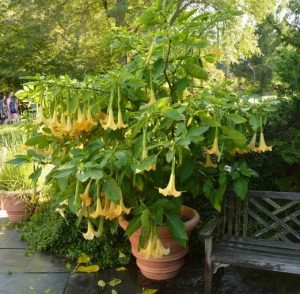
- Weed and fertilize your containers.Water as needed, which is usually once per day. The plants are now beginning to approach their mature size and it is important to keep them well fed and hydrated. If you used slow release fertilizer pellets in your containers, you may wish to consider a reapplication near months end. Most fertilizer pellets only last 2 or 3 months and the rate of release increases as the temperatures soar above 85°F. For heavy feeders, like Brugmansia (picture above right) you should supplement slow release feed with liquid fertilizer – the slow release granules do not release the nutrients at a sufficient rate to support blooming.
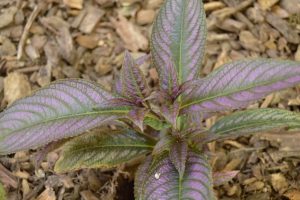
- Some annuals, such as Coleus, Plectranthus and Persian Shield (Strobilanthes) would benefit from an occasional pinching of the tip, allowing lower buds to break dormancy and grow (as seen at right, 2nd picture, for Persian Shield). This allows the plants to become denser and prevents them from getting straggly or becoming excessively large and ‘eating’ the neighboring plants.
- Hanging baskets should receive a serious cutback in order to renew the plants for a late July through September display.
- Irrigate perennial and annual gardens for long periods ensuring a deep penetration of water into the soil should rainfall become scant.
- It is now ok to remove the old foliage of Narcissus as it is now turning yellow and next year’s bulbs have fully developed.
- Reapply mulch to retain moisture should it have become thin or disturbed through replanting of annuals or perennials or from weeding. Mulch only needs to be a total of 2-3” thick including older mulch and newly applies.
- For turf grass, raise the cutting height to 3” during these hotter and drier months to reduce plant stress. If you irrigate, do so for extended periods during the early morning to encourage deeper root growth. Try not to water in the evening, since that will promote various fungal problems. Avoid fertilizing turf during July and early August as that will necessitate more irrigation.
- For Roses, deadhead or remove the old flower blossoms, give them a light feeding and remove any leaves from the plant or on the ground that have blackspot, as this will help to reduce future outbreaks.
- Any Japanese Beetles on roses or other plants can be destroyed by flicking them into soapy water.
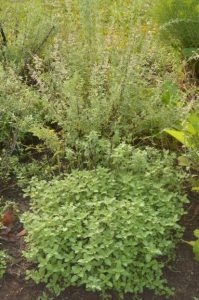
- Some perennials can be lightly trimmed such as the early blooming Salvias (Salvia nemorosa) or more heavily cut back such as Catnip (Nepeta faassenii) and Ribbon Canary Grass (Phalaris arundinacea var. picta) to initiate prolonged blooming or attractive foliage into the fall. Nepeta ‘Walkers Low’ is photographed at right 2 weeks after being cut back, with an unpruned specimen behind. Make certain you provide adequate irrigation if you cut the plants back hard. I leave the dried flowers of Yarrow (Achillea) and Astilbe on the plant, as they look attractive in the fall and winter. Early July is the latest time to pinch back unruly Asters and Chrysanthemums, since pinching any later will delay the bloom time too late into the fall.
- Weed! Even with the limited rainfall and heat, there is an endless growth of weeds. It is best to get them young before they become too noticeable and the root systems become too established. Worse yet, try not to let them seed, as the average lifespan of a seed is 7 years which equates to 7 more years of weeding! Mulching heavy does not equate to less weeds either, and will lead to more issues in the future since excessive mulch is not healthy for plants.
- Peas, radishes, lettuce, spinach and other cool season crops need to be removed, composted and replaced by beans, beets or any 80 day to maturity crop. Thin carrots to roughly 1” apart and beets to 2” to allow room for proper root development.
- At this point summer squash and cucumbers are beginning to come of size; harvest them small (4-6”) and frequently to ensure continued yields and tenderness. If you planted potatoes, they can also be harvested starting in mid-July. A second crop of cucumbers can be planted now to replace those planted earlier that will begin to loose vigor come late August and September.
- Check parsley for Black Swallowtail Butterfly eggs or caterpillars.
- If your Zucchini Squash gets the borer early in the season and collapse, and you still wish to grow squash in that location for this year, consider planting some of the Scallop Squash, often called Patty Pan Squash for an autumn harvest. They mature in about 50-54 days from seed and come in solid White, Golden, and a combination of White and Green Striped. Not only are they delicious, they will add color to the Thanksgiving Table as well!
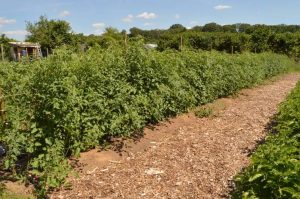
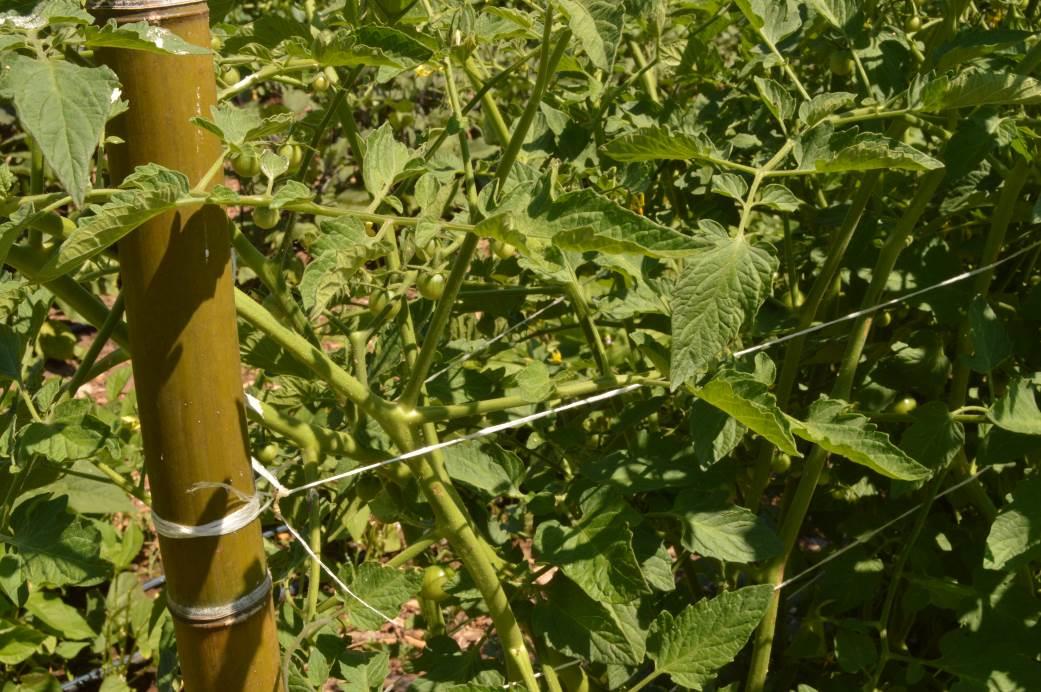
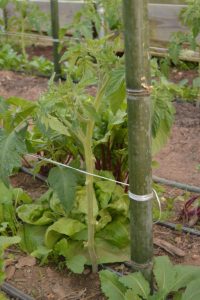
- When watering tomatoes, make certain that the fruit remains dry in order to reduce the occurrence of blossom end rot. Keep the tomatoes staked (as seen at right). By positioning poles along a row of tomatoes and holding the tomatoes upright between two strings, the fruits can be kept off the ground, air can circulate through the plant (reducing disease risks) and ripening fruit is better seen. A close-up of how the plants are supported is pictured below, with the green arrows pointing to the twin strung on either side that was installed as the plants were growing in June and July.
- Maintain even moisture in the soil around tomatoes to reduce the risk of the tomatoes splitting. This is particularly true of Heirloom tomatoes and using a straw mulch will help maintain consistent moisture.
- Yellowing of the lowest leaves on the stems of tomatoes is an indication of Early Blight. It is best to remove these lower leaves, such that there is no contact with the soil and reducing the threat of future outbreaks. Also, wash your hands after removing the leaves before touching other plants to reduce the chance of spreading the disease.
- Provide a light pruning and training of rampant growing Wisteria stems, stray stems of Clematis, and other vines. A heavy pruning will invigorate excessive vegetative growth and less flower bud development.
- Prune water sprouts and suckers on small trees and large shrubs before they become too large and begin to deform the plant.
- With young ornamental and shade trees, you may wish to prune off or thin the lowest hanging branches if you have not already done so, as they will continue to droop lower until growth ceases towards mid-month. These low hanging branches shade out any plantings beneath, blocking important views of the garden and make walking about difficult. Remember, to cut branches back to – but not into – the branch collar at the base of the branch. Continue to visit local garden centers as new materials are continuing to arrive and there may even be a couple of mid-summer sales beginning!
Bruce Crawford
State Program Leader in Home and Public Horticulture (NJAES)
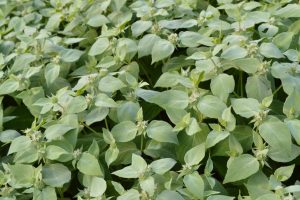 Personally, I was not introduced to this plant until 2010 while touring Central Park. It appeared periodically throughout the park as a 2-3’ tall mass of shimmering silver along the edge of woodlands and ponds. Although the day was cloudy and it was mostly growing beneath a canopy of tall trees, the plant gave the impression of sunlight cutting through openings in the branches and illuminating the forest floor beneath. The gentleman leading the tour mentioned how these masses of Mountain Mint had been installed in an effort to reduce weeds. Naturally, I thought it was another invasive mint and was about to dismiss the plant when he noted it was merely a dense, ‘weed-suppressing’ plant and not invasive. A weed suppressing, non-invasive mint – my interest in this plant began to grow!
 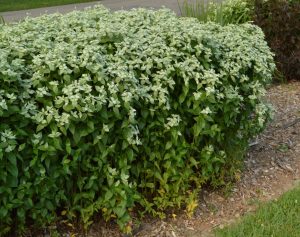 The lance-shaped, dark green foliage, measures 2-2 ½ inches long and is much like a typical mint, the foliage is very aromatic when rubbed. Tightly clad to the square stems by only a short petiole, the foliage contains pulegone, an oil with an aroma reminiscent of spearmint that is very effective at repelling mosquitoes when rubbed on the skin. This aroma is also effective at eliminating deer browse!
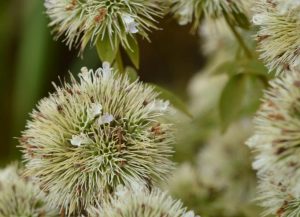 If more of a clump forming species is of interest consider Pycnanthemum flexuosum or Appalachian Mint. Originally named Origanum flexuosum in 1788 by the American botanist Thomas Walter (1740-1789), its name was altered a century later in 1888 by Nathaniel Lord Britton (1859-1934). Britton was the American botanist who went on to cofound the New York Botanical Garden! The species epithet means pliant and is probably a reference to the flexible stems. Growing 2-3’ tall and roughly as wide, the dense root system is great for soil stabilization and since the foliage is also aromatic, it too is resistant to deer browse. The flower clusters or cymes lack the silvery bracts of its cousin, but they are much larger, typically around 1 ½” in diameter (as pictured at right). The purple flecked, white flowers remain rather diminutive, with the ¼” long tubular flowers appearing for nearly 2 months throughout the summer. Like its cousin, they are also exceptionally attractive to pollinators. Unlike its cousin, each flower has a more pronounced calyx or leafy base that initially serves to protect the flower bud and then physically support the tubular flower. Once the flower fades and drops away, each of the 5 off-white sepals that compose the calyx have a long bristly spur at the tip, giving the flower head a Sputnik or fuzzy appearance. The ultimate effect produces a bit more drama to the flower and the Garden, which I found very ornamental! This species has similar cultural requirements as its cousin and both are hardy throughout NJ, easily enduring a zone 5 winter and the summer’s heat.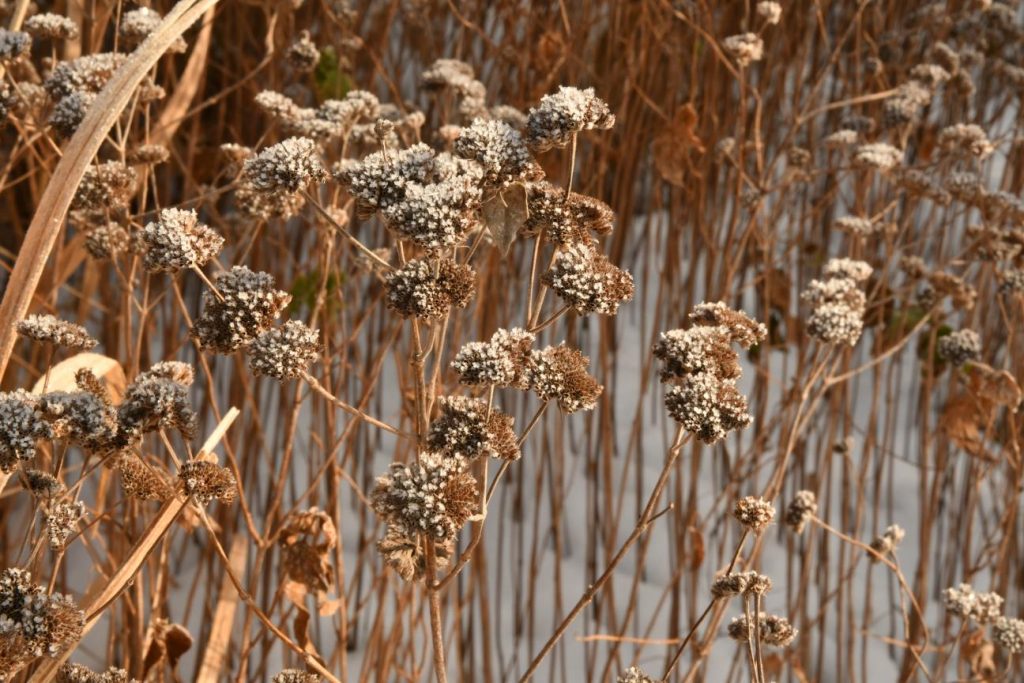
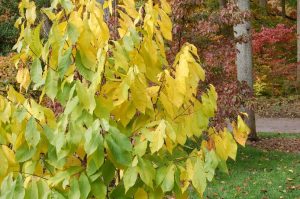 The genus is still in existence with around 166 species and was derived from the Taíno word Anón for fruit. Taíno was the name of the culture of indigenous people in the Caribbean prior to the arrival of the Spanish. The genus name of Asimina was penned by the French Botanist and Naturalist Michel Adamson (1727-1806) in 1763. The word was adopted from Assimin or Rassimin, as the tree was so named by the Native American Algonquian Indians. It was not until 1817 that the French Botanist Michel Felix Dunal (1780-1856) properly described the tree as Asimina triloba, although the tree continued to undergo various renditions until 1886 when it was conclusively decided by the American Botanist,
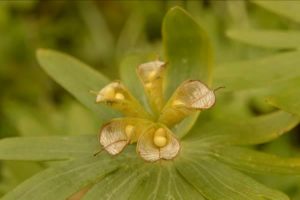
 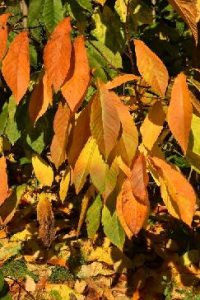 Asa Gray (1810-1888) that Dunal was correct. The species epithet means 3 lobes and describes the double whorl of 3 petals that comprise the flower (see images below). The common name of Pawpaw is believed to have come from the Spanish Papaya due to the similarity of the fruit shape, size and taste.
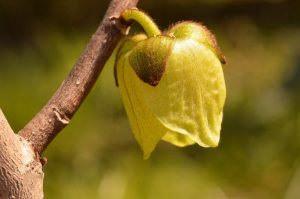 The flower buds open sequentially from the inner reaches outward, which is a great adaption in case of an unexpected late spring frost; the closed flower buds are not impacted by the chill and subsequently continue to open and ultimately bear fruit! The flowers are initially a pale green on opening as pictured above, but gradually change to a deep ‘meaty’ red at maturity. The flowers consist of an outer whorl of 3 lightly pubescent sepals or modified leaves that are also initially green before developing dark red highlights with age. The sepals and flower stem are lightly pubescent and are located at the top of the flowers once open as seen above. The six petals are arranged in two distinct tiers of three, with a larger outer whorl and a puckered inner whorl (as seen at left).
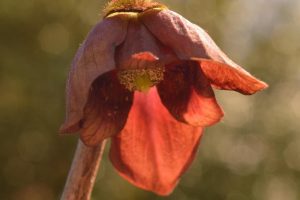 The flowers have a slightly fetid odor, which in combination with the deep red color of the flower provides the clues for which creatures serve as pollinators – namely flies and beetles! Not to worry, I have never seen flies hovering around the trees and there is always good fruit set. It is important to plant several different clonal selections of Pawpaw, since the trees are not self-fertile and require at least two genetically different plants for pollination. The species exhibit what botanist call protogynous dichogamy, whereby the female stigma and the male anthers mature at different times, preventing self-pollination and inbreeding depression. My experience has been pruning the plants into a somewhat planar or two dimensional configuration, combined with removal of the root suckers helps to enhance flowering and fruiting.
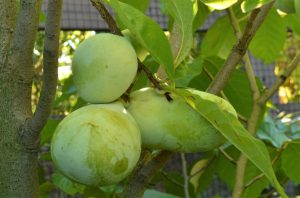 a smoothie or used in baking. Using a spoon is also handy since the fruits have two rows of large dark brown seeds that are challenging to eat around! The fruit has to be picked when ripe since, at least in my experience, they fail to ripen if picked too early. They also have a very short shelf life of only a few days, although the pulp can be frozen for up to a year if properly processed. Aside from sweet tasting, the fruit is also very nutritious, containing healthy amounts of Vitamin C, Magnesium, Iron, Copper and Manganese. They are also a good source of Potassium and antioxidants.