

As we experienced a year ago, the act of getting out into your Garden continues to be a great option as many of us continue to work at home. Plants continue to display their beauty and working in the soil and seeing things grow is a very calming. This will probably be a year that many homeowners continue to grow their own vegetables, and the garden retains its importance to many home gardeners. As the sun and warmth of April unfold, take a deep breath and prioritize what must be completed vs. what could be postponed for a day or two. Remember, gardening is our hobby and we do not need any more pressures or deadlines in our life!
Things to do:
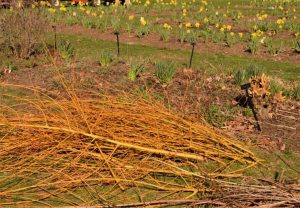
- Finish pruning roses, small trees, and coppiced shrubs early in the month. Techniques for pruning red and golden-stemmed dogwoods (Cornus sanguinea cultivars) and willows (Salix), depends upon the deer browse pressure. Either ⅓ to ½ of the older stems can be cut back to 6-12” or the entire plant can be cut to that height as seen in the image below of a Red Stemmed Willow (the pruned plant is at the right of the image). Leaving some of the existing stems helps protect the young shoots from deer predation. Shrub roses can be cut in half to prevent them from becoming overgrown, while the stems of hybrid tea roses should be cut down about 2/3’s to a bud that is facing outward. Hydrangea arborescens cultivars can be cut back to 3”; Hydrangea paniculata cultivars can either be cut back severely to 12” or pruned lightly, leaving a 3-4’ tall framework for new growth to emerge; Hydrangea macrophylla should be thinned with the oldest and most branched stems cut to the ground while Hydrangea quercifolia should simply be lightly shaped.
- For ornamental flowering trees, thin out any water sprouts or ‘suckers’ that appear on branches that will grow into and become abrasive to existing branches above. Branches that rub against each other damage the bark and allow air and decay to impact the branches.
- Finish cutting back ornamental grasses and perennials.
- If you overwintered bananas outside (such as Musa basjoo), remove the insulating leaves and the surrounding wire cage.
- Divide grasses and perennials if necessary. Remember that the center portion of the plant is the oldest and least vigorous and should be discarded. The outer, more vigorous ring will yield at least 10 new plants, with 9 of those going to friends, a new garden, or a curbside sale!
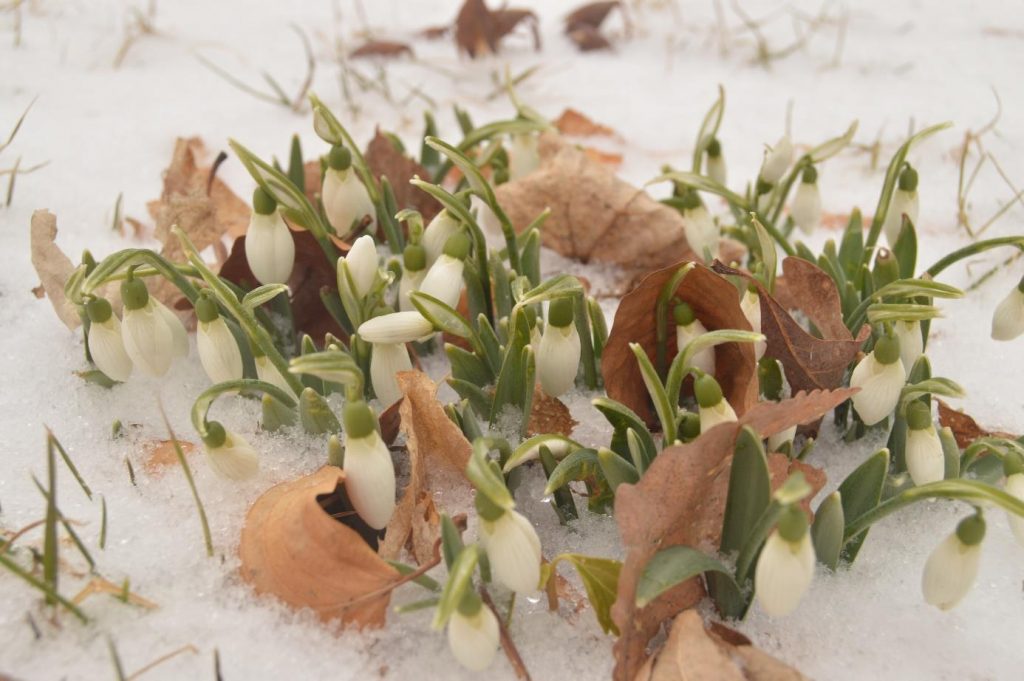
- As soon as the early blooming bulbs (such as Snowdrops, Winter Aconites, Snowflakes and Scilla) have finished blooming, the clumps can be dug, divided and moved about the garden if so wished. These bulbs are much more successfully spread about in spring while still actively growing than when purchased as dormant bulbs in autumn. It is also financially more prudent!
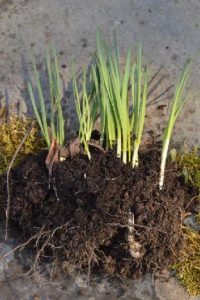
- If your Narcissus have stopped blooming, they may be planted too shallow or are in need of division. Plants can be dug, divided and replanted while in leaf, as seen at left.
- Continue potting up Canna, Banana, Alocasia and other tropical plants that were overwintered in the basement. Make certain to test the tubers to ensure they have no soft spots or decay
- Edge bedlines and compost the pieces of turf that have been removed.
- Finish thatching and raking lawns. Apply a pre-emergent crabgrass control to established lawns before or during Forsythia bloom, if crabgrass was a severe problem in 2020.
- Apply fertilizer and lime to lawns and Vegetable Gardens as prescribed by soil test results.
- Apply corn meal gluten to flower beds as a weed pre-emergent and mild fertilizer as an organic alternative.
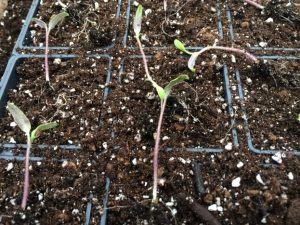
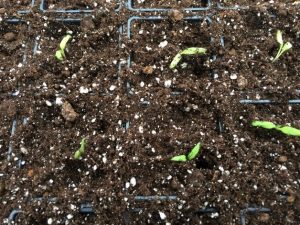
- For the Vegetable Garden, finish sowing tomato, pepper, and eggplant seeds. Earlier seeded Lettuce, Swiss chard, broccoli and cabbage seedlings can now be planted outside, especially under low tunnels or in containers. Many new gardeners do not realize how many vegetables can be grown on a sunny deck in a container! For tomatoes, if you sowed your seed in a tray and the first leaves or Cotyledons are now well developed, tease apart the seedlings and install the plants in individual cells. Tomato seedlings can be planted deep, since roots will develop along the entire stem, providing a stout and strong plant (see images above –planted too shallow on the left, planted to the proper depth on the right).
- Resist the urge to turn over or work the soil of your vegetable garden if the soil is too moist. In fact, try not to even walk on the soil if possible. If you can make baseballs from the soil, it needs a few more days to drain.
- It is best to actually put a soil fork into the ground and rock it back and forth to loosen the soil, vs rototilling. Breaking apart the soil damages soil borne mycorrhizae, which in turn enhance the growth of your vegetables!
- Early in April for those in Southern locations, later for those more Northern areas, seed can be sown directly in the garden for Beets, Carrots, Spinach, Cilantro, Lettuce, Arugula, Mustard Greens, Bok Choy, Peas and Turnips.
- It is time to plant potatoes, as they are typically planted 2-3 weeks prior to the frost free date (May 15 in central NJ). Only use ‘seed’ potatoes from a seed company and resist using potatoes that you have bought at a grocery store that are sprouting!
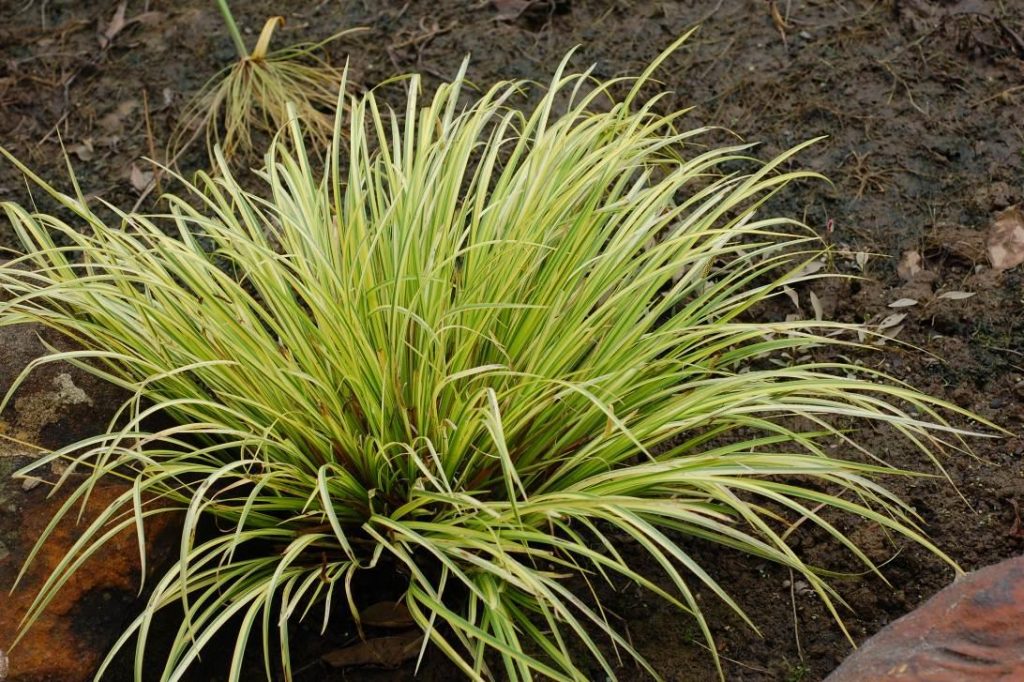
- Remove the wintergreens from containers and plant bulbs, pansies, primroses, evergreen grasses, etc for early spring color. Consider using the grassy foliage of Acorus gramineus ‘Ogon’, the Golden Sweet Flag pictured below, as a chartreuse accent plant for spring containers! Also consider many varieties of Lettuce and Swiss Chard, as they are also very attractive and mix well with Pansies and Primroses. Plus, you can harvest a meal right from your containers!
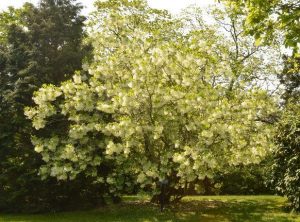 In general, Chionanthus virginicus is slow growing, appearing naturally in moist woodlands along stream banks and in exposed rocky glades. It frequently appears as a multi-stemmed shrub, reaching 15-20 feet tall and slightly wider, as pictured at right in the Morris Arboretum. However, under perfect conditions, they can reach heights of 30 feet by equal or greater widths. Depending upon the year and location, the white flowers that inspired the name can appear in late April, although May into early June is more typical for NJ. The floral display lasts for upwards of 2 weeks and looking up into a canopy of the pendant flowers can be a very transformative moment for the gardener! The flowers emerge from buds at the base of the leaves or leaf axils and freely dangle along the stems. The flowers are arranged in panicles, which have a central stem with three-flowered clusters radiating outwards along this stem. The overall panicle ranges from 4-10 inches long and up to 6 inches wide. The plants are dioecious, with individual plants having all male or all female flowers, a trait certain species adopted to prevent self-pollination and inbreeding depression. The individual flowers consist of 4-6 strap-like lobes or petals that are up to 1 inch long on the female and slightly longer on the male flowers, by 1/16” wide (as pictured at right).
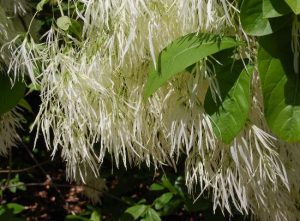 The flowers are wonderfully fragrant and give the plant a very appealing lacy or fringe-like appearance that gave rise to its common name. In some regions the plant is also called Old Man’s Beard, since the dangling panicles resemble a frothy white beard! The male flowers have 2 stamens that aid in making the flowers appear showier, while the female flowers have a single central stigma. Although the male flowers may be showier, it is the female flowers that develop clusters of blue to purple fruits come September. The fruits are technically called a drupe, with each containing a single large central seed. The drupes are much beloved by birds and are a good reason for not planting a clonal mass of simply the showier male selections. The fruits are equally vital to the garden, if not more so, for their attractive display and provisions provided for wildlife (pictured below in late November).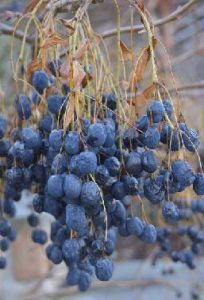
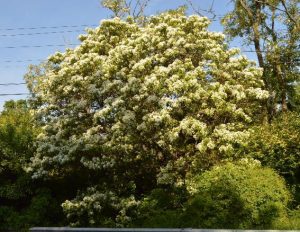 Chionanthus retusus also has dioecious flowers. The flowers differ from their North American cousin by being erect and produced from the apical buds at the tips of the branches. Although the panicles are smaller, only reaching 2-3 inches long and as wide, the petals are wider, reaching from ⅛ to nearly ¼ inch wide (as seen below). The wider petals combined with the apical positioning of the flowers provides for a more dense and brilliant floral display (pictured at left), which is attractive yet not quite as ethereal as its cousin in my opinion.
 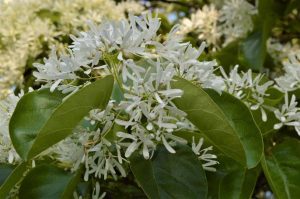 The bark is showier on this species, as the younger stems are cinnamon brown in color with small waves of peeling bark running the length of the stems. Over time, the bark matures to a dark brown and gradually becomes ridge and furrowed.
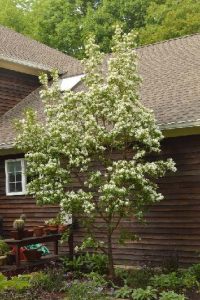 Both species of Fringe Tree perform admirably in full sun or light shade and are very adaptable to a broad range of soil types and pH. I have seen large specimens of Chionanthus retusus planted near busy roadways where they are subject to significant amounts of road salt throughout the winter without any noticeable impact. The American Fringe tree is hardy to zone 3 and while the Chinese Fringe Tree is only hardy to zone 5, they are both suitable for NJ gardens. The one issue to consider and keep an ever watchful eye out for is Emerald Ash Borer, as both species are susceptible.
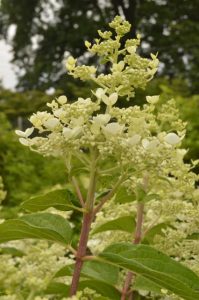 or just receive a light pruning if the flowers are dense with sterile florets. Purple and Golden Smoke Bush should be cut back to 6-12” to provide optimum foliage color, although such treatment will sacrifice summer blooms. Red or Golden Stemmed Dogwoods and Willows should be cut back to 6” or less every 2-3 years to encourage new shoots to develop, which will sport the best red or gold stem color. Have had great success with cutting red stemmed willows (Salix alba ‘Britzensis’) back annually. Vitex (Chaste Tree) can be cut back hard (to 12”) or moderately (3’), depending upon how tall you wish the plant to grow in your Garden – obviously, the less you cut it back, the taller the plant will grow this season.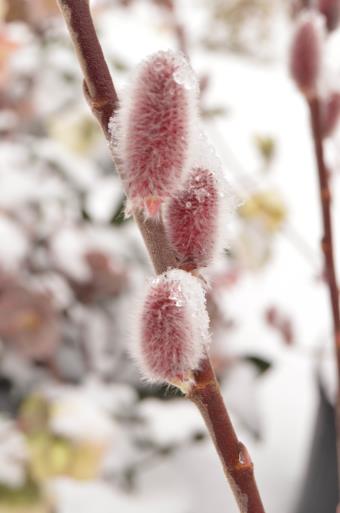
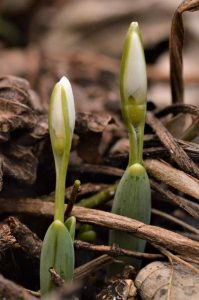 The most common species planted in Gardens, and very deservedly so I might add, is Galanthus nivalis. This species is also the type species for the genus, against which all species are evaluated and compared. This species was also named by Linnaeus in 1753, with the species epithet coming from the Latin meaning ‘of the snow’ or ‘snow-covered’. Typical to the genus, each bulb produces two linear leaves that ultimately grow to 6-8” long. The flower scape emerges from in-between the leaves when they are merely 1-2” tall as seen at left. The flower scape ultimately stretches to 6-8” tall as well and terminates in what appears like a shepherd’s crook, with the flower dangling from the center of the crook (see image below of Galanthus elwesii). When the flower initially emerges from between the leaves, the bud is held upright and is enclosed by a protective leafy bract or spathe. The spathe consists of two modified leaves called spathe valves and two transparent membranes. The spathe valves are located on either side of the flower bud and appear as slender green lines, as seen in the image above.
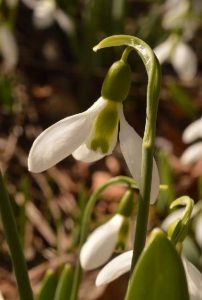 The two transparent membranes are connected to the spathe valves and wrap around the bud. As the bud expands, the membranes split open and fall away, while the 2 spathe valves elongate and curl downward, forming the ‘shepherd’s crook’, as the image of Galanthus elwesii depicts at right. As the spathe valves elongate, the flower bud transitions from an upright bud to a dangling flower, located near the center of the spathe valves. An incredible ‘dance’ and fun to watch evolve if time permits!
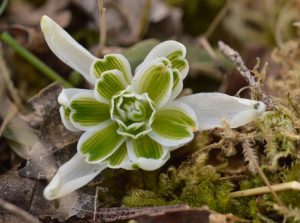 The compressed growing period pressures the genus to produce as many carbohydrates as possible for generating seed and developing new bulbs for the following year. Albeit small, these green markings aid in the production of the needed sugars! Interestingly, the foliage and tepals also contain small air-filled spaces that allow the flowers to tolerate subfreezing temperatures as they begin to bloom. The globe shaped ovary is located above the tepals, with the small black seeds maturing in mid to late May. The seeds have an attached lipid rich structure called an elaiosome, which not only feeds and attracts ants, but serves as a means of seed dispersal.
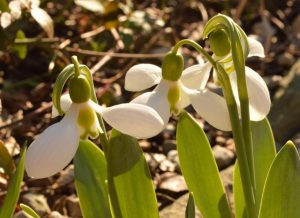 Another readily available species is the formerly mentioned Galanthus elwesii. The plant resembles its cousin in all aspects except it is larger with the outer tepals reaching an inch or longer in length. They are often the first species to emerge and feature green markings on both the upper and lower ends of the inner tepals. They can even be connected, as seen at right. The larger outer tepals results in a flower upwards of 2” in diameter when fully open! The species honors the British botanist and entomologist Henry John Elwes (1846-1922), who came across a mass of large flowered Snowdrops in 1874 while botanizing in the mountainous regions near Smyrna, Greece. In 1875, the English botanist Dalton Hooker (1817-1911) honored Elwes with the species epithet. Interestingly, the plant that Elwes found was actually a previously described species named Galanthus gracilis and Hooker’s species name was used to describe another, as of yet unnamed large flowered species!
 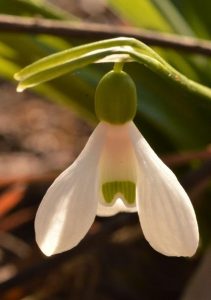 Another delicate and very attractive species is Galanthus ikariae. Named by John Gilbert Baker (1834-1920) in 1893, it is native to several Greek islands in the Aegean Sea, including the island of Ikaria for which it is named. If the island’s name sounds familiar, it is named after Icarus, who in Greek legend escaped from King Minos by fabricated wings from feathers connected by wax. When he flew too close to the sun, the wax melted and he fell to earth. Legend has it he was buried on this island that bears his name! This species bears smaller pendant flowers to 1” long and a single green mark on the tips of the inner, bi-lobbed tepals (pictured at right). Often, this green mark will extend half way or further up these tepals. The foliage is glossy and more attractive than the mat-green forms, growing to 6-8” tall. Not ideal for plugging into turf since the reflective foliage does not blend well with turf grass. In the wild, the plant is often found in river valleys, growing with Cyclamen hederifolium in deep humus rich soils. It has also been found in upland gravely soils in scrubby growth. The plant is somewhat less winter hardy, but I have not had any issues in over 30 years of growing the plant. Unfortunately, it does not appear to naturalize as readily as other species.