

Adequate April showers combined with seasonally appropriate temperature has provided early May with a very nice assortment of spring blooming plants. Although rather chilly for those looking forward to those summer days of 90 degrees, the cool weather will allow spring blooms to last and to be enjoyed to their fullest! May is always a hectic month, so take the time to make notes in your journal and take long evening strolls to smell and enjoy the fruits of your efforts.
Things to do:
- Prune leggy Azaleas and Rhododendrons as they finish blooming. This will improve the habit or shape of the plant while still ensuring flower bud development for next year.
- By late May it will be clearly evident which parts of a plant – if not the whole plant – has died back from winters chill and snowpack. Always check the base of the stems to see if mice have girdled any stems, often a problem when the snowpack has persisted for a long period of time.
- If you have fertile soils, some perennials such as New York and New England Asters as well as the taller Sedums should be pinched in mid to late May to prevent them from flopping later in the season.
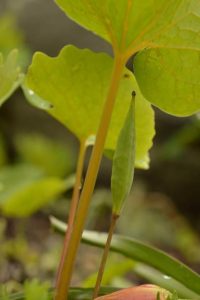
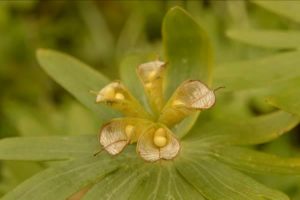
- Some plants such as Bloodroot (Sanguinaria canadensis) can be easily sown in the garden by seed. Look under the foliage for the seed pods (pictured at right) and lightly squeeze the pod. If it splits open, the seeds are rip and spread them close to where you would like to add some plants. I say close since the seeds are moved about by ants, so the planting will take on a very naturalistic appearance, based upon where the ants finally drop the seeds! Other plants such as Winter Aconites (Eranthis) have seed that is dispersed out of the open, cup-shaped seed capsules by wind. As the plants rock back and forth, the seed is tossed a short distance from the capsules (as seen in the 2nd picture at right) and they will germinate the following spring. Longwood Gardens has found distributing the plant by seed to be a far more successful method of spreading the plants about than the typical method of installing the tubers in the fall.
- Let bulb foliage turn yellow or tan before removing to ensure proper bulb and flower development for next year. Do not tie it together or braid it, since that reduces that amount of surface area exposed to the sun and its ability to make both sugars and next year’s embryonic flowers.
- For bulbs such as Eranthis (Winter Aconite) and Galanthus (Snowdrops), dig and divide existing clumps as you will have far more successful results replanting the geophytes (plants with an underground storage organ, like a bulb or a corm) than planting newly purchased ‘bulbs’ in the fall!
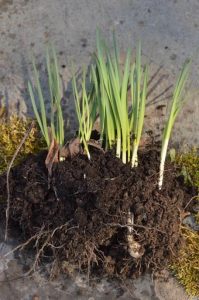
- If your Narcissus (Daffodils) failed to bloom this year, it may be they are planted too shallow for the bulb to grow to the proper size to bloom. Dig them in late May (as pictured at right), tease apart the clump into several smaller clumps and replant around 6” deep. In the clump pictured at right, notice the small bulb size of the one pulled down lower, far too small to yield a flower!
- For a neat garden, edge those bedlines and compost the remnants!
- Always make certain the soil has drained adequately before working it, as disturbing the soil while too wet will destroy the soil structure. If you can make the soil into a baseball, it is probably too moist!
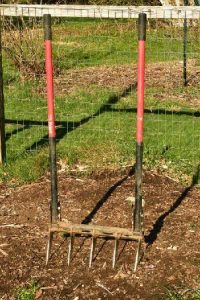
- For vegetable gardens, use a broadfork to gently loosen and aerate the soil. A broadfork has 3-5 sharp tines that penetrate into the soil with two 5’ long handles (as pictured at right). By using your body weight against the handles and rocking back and forth, the soil is loosened but not disrupted. Tilling the soil damages both the earthworms who help aerate the soil and beneficial fungus, which assist the vegetables in obtaining nutrients and water. Current research shows that the fungus also produce and transfer the amino acid Ergothioneine to vegetables. Ergothioneine is an antioxidant with anti-inflammatory properties that has been shown to battle chronic illness and allow people to live longer. You have to love fungus! Get the soil for Vegetable Gardens tested for nutrients and pH level if it has not be tested in a couple of years.
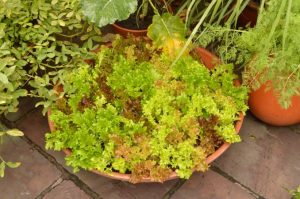
- If you are looking to ease into growing vegetables or you only have a deck, plant your cool season crops in containers. They are both ornamental and delicious (bottom picture on right)!
- Thin those cool season vegetables like beets that were directly sown during April. Thinning will allow them to develop more fully and the greens from the thinned beets can be added to salads!
- Start to plant frost tender vegetables. For the eager, the wall of water can be used for tomatoes and other tender vegetables that are planted during the potentially cold first half of the month, although there is no harm in waiting until early June! In fact, adding a second planting of tomatoes in early to mid-June will help to ensure tomato harvest through September.
- Plant out tender annuals after the last frost-free date in your part of the state (generally May 15th, but frosts can occur later). Temperatures in May can fluctuate from 90° one day to 30° the next! Also, certain annuals that like it warm, such as Catharanthus (the annual Vinca) and ornamental Sweet Potato Vines should not be planted until late May or early June for best results.
- Remove the Banana and Cana roots from the basement and plant them in a sunny location in soils that are enriched with compost to help hold moisture.
- The Colocasia and Alocasia roots or potted plants can be planted out in early May. They are surprisingly tolerant of cooler temperatures when young.
- Pot up the Dahlia tubers or plant them directly in the soil come late May.
- Cut those lawns. Remember, 2 ½ – 3” length is far healthier for the turf than a 2” cut. Do not remove the clippings unless they are exceptionally thick, since they release nitrogen back into the soil as they break down.
- Spot treat for dandelions or any other aggressive lawn weed.
- Finish mulching perennial or shrub borders during the early part of May and start to weed! Remember the average weed seed’s life is 7 years, so remove those weeds before they go to seed.
- Frequently visit local garden centers as new additions are coming in weekly.
- Read the notes that you made this winter and last May and reflect on how to improve the garden. It is now time to put your thoughts into action!
Bruce Crawford
State Program Leader in Home and Public Horticulture (NJAES)
 The genus is still in existence with around 166 species and was derived from the Taíno word Anón for fruit. Taíno was the name of the culture of indigenous people in the Caribbean prior to the arrival of the Spanish. The genus name of Asimina was penned by the French Botanist and Naturalist Michel Adamson (1727-1806) in 1763. The word was adopted from Assimin or Rassimin, as the tree was so named by the Native American Algonquian Indians. It was not until 1817 that the French Botanist Michel Felix Dunal (1780-1856) properly described the tree as Asimina triloba, although the tree continued to undergo various renditions until 1886 when it was conclusively decided by the American Botanist,
 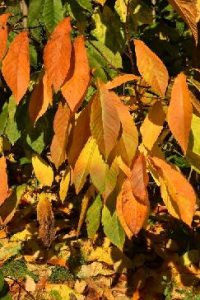 Asa Gray (1810-1888) that Dunal was correct. The species epithet means 3 lobes and describes the double whorl of 3 petals that comprise the flower (see images below). The common name of Pawpaw is believed to have come from the Spanish Papaya due to the similarity of the fruit shape, size and taste.
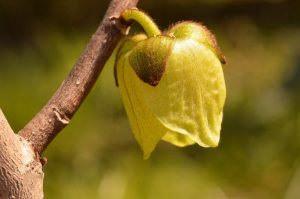 The flower buds open sequentially from the inner reaches outward, which is a great adaption in case of an unexpected late spring frost; the closed flower buds are not impacted by the chill and subsequently continue to open and ultimately bear fruit! The flowers are initially a pale green on opening as pictured above, but gradually change to a deep ‘meaty’ red at maturity. The flowers consist of an outer whorl of 3 lightly pubescent sepals or modified leaves that are also initially green before developing dark red highlights with age. The sepals and flower stem are lightly pubescent and are located at the top of the flowers once open as seen above. The six petals are arranged in two distinct tiers of three, with a larger outer whorl and a puckered inner whorl (as seen at left).
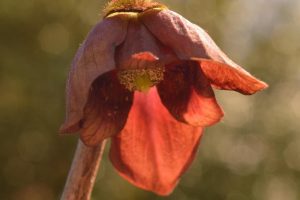 The flowers have a slightly fetid odor, which in combination with the deep red color of the flower provides the clues for which creatures serve as pollinators – namely flies and beetles! Not to worry, I have never seen flies hovering around the trees and there is always good fruit set. It is important to plant several different clonal selections of Pawpaw, since the trees are not self-fertile and require at least two genetically different plants for pollination. The species exhibit what botanist call protogynous dichogamy, whereby the female stigma and the male anthers mature at different times, preventing self-pollination and inbreeding depression. My experience has been pruning the plants into a somewhat planar or two dimensional configuration, combined with removal of the root suckers helps to enhance flowering and fruiting.
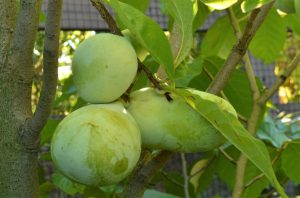 a smoothie or used in baking. Using a spoon is also handy since the fruits have two rows of large dark brown seeds that are challenging to eat around! The fruit has to be picked when ripe since, at least in my experience, they fail to ripen if picked too early. They also have a very short shelf life of only a few days, although the pulp can be frozen for up to a year if properly processed. Aside from sweet tasting, the fruit is also very nutritious, containing healthy amounts of Vitamin C, Magnesium, Iron, Copper and Manganese. They are also a good source of Potassium and antioxidants.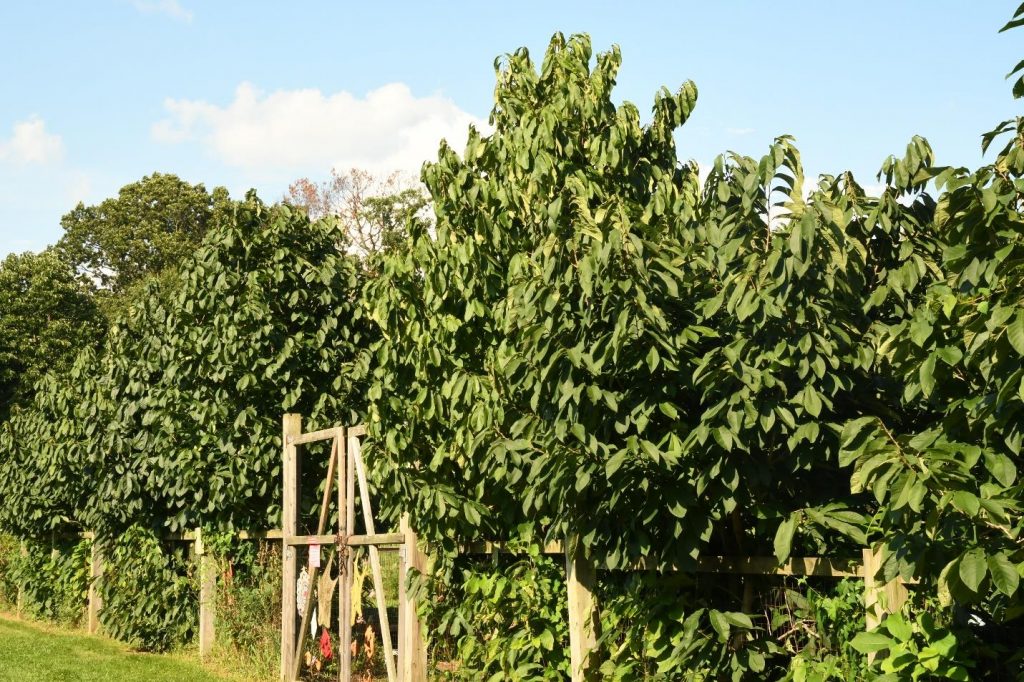
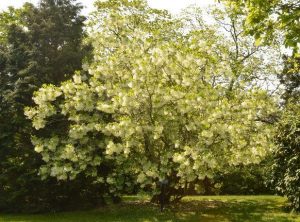 In general, Chionanthus virginicus is slow growing, appearing naturally in moist woodlands along stream banks and in exposed rocky glades. It frequently appears as a multi-stemmed shrub, reaching 15-20 feet tall and slightly wider, as pictured at right in the Morris Arboretum. However, under perfect conditions, they can reach heights of 30 feet by equal or greater widths. Depending upon the year and location, the white flowers that inspired the name can appear in late April, although May into early June is more typical for NJ. The floral display lasts for upwards of 2 weeks and looking up into a canopy of the pendant flowers can be a very transformative moment for the gardener! The flowers emerge from buds at the base of the leaves or leaf axils and freely dangle along the stems. The flowers are arranged in panicles, which have a central stem with three-flowered clusters radiating outwards along this stem. The overall panicle ranges from 4-10 inches long and up to 6 inches wide. The plants are dioecious, with individual plants having all male or all female flowers, a trait certain species adopted to prevent self-pollination and inbreeding depression. The individual flowers consist of 4-6 strap-like lobes or petals that are up to 1 inch long on the female and slightly longer on the male flowers, by 1/16” wide (as pictured at right).
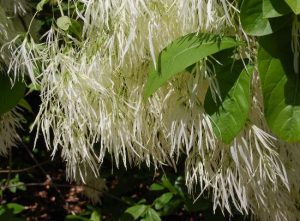 The flowers are wonderfully fragrant and give the plant a very appealing lacy or fringe-like appearance that gave rise to its common name. In some regions the plant is also called Old Man’s Beard, since the dangling panicles resemble a frothy white beard! The male flowers have 2 stamens that aid in making the flowers appear showier, while the female flowers have a single central stigma. Although the male flowers may be showier, it is the female flowers that develop clusters of blue to purple fruits come September. The fruits are technically called a drupe, with each containing a single large central seed. The drupes are much beloved by birds and are a good reason for not planting a clonal mass of simply the showier male selections. The fruits are equally vital to the garden, if not more so, for their attractive display and provisions provided for wildlife (pictured below in late November).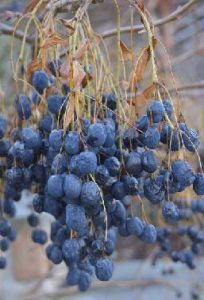
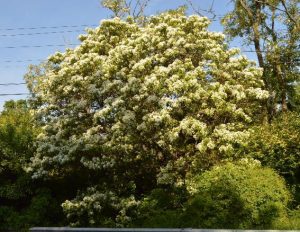 Chionanthus retusus also has dioecious flowers. The flowers differ from their North American cousin by being erect and produced from the apical buds at the tips of the branches. Although the panicles are smaller, only reaching 2-3 inches long and as wide, the petals are wider, reaching from ⅛ to nearly ¼ inch wide (as seen below). The wider petals combined with the apical positioning of the flowers provides for a more dense and brilliant floral display (pictured at left), which is attractive yet not quite as ethereal as its cousin in my opinion.
 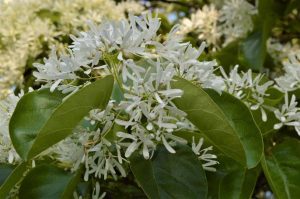 The bark is showier on this species, as the younger stems are cinnamon brown in color with small waves of peeling bark running the length of the stems. Over time, the bark matures to a dark brown and gradually becomes ridge and furrowed.
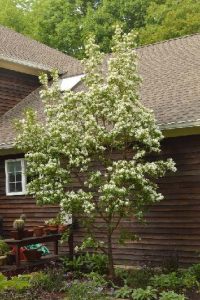 Both species of Fringe Tree perform admirably in full sun or light shade and are very adaptable to a broad range of soil types and pH. I have seen large specimens of Chionanthus retusus planted near busy roadways where they are subject to significant amounts of road salt throughout the winter without any noticeable impact. The American Fringe tree is hardy to zone 3 and while the Chinese Fringe Tree is only hardy to zone 5, they are both suitable for NJ gardens. The one issue to consider and keep an ever watchful eye out for is Emerald Ash Borer, as both species are susceptible.
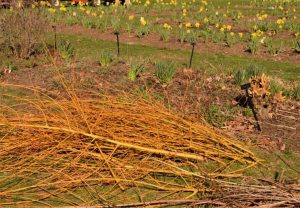
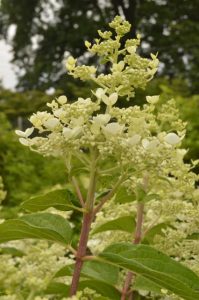 or just receive a light pruning if the flowers are dense with sterile florets. Purple and Golden Smoke Bush should be cut back to 6-12” to provide optimum foliage color, although such treatment will sacrifice summer blooms. Red or Golden Stemmed Dogwoods and Willows should be cut back to 6” or less every 2-3 years to encourage new shoots to develop, which will sport the best red or gold stem color. Have had great success with cutting red stemmed willows (Salix alba ‘Britzensis’) back annually. Vitex (Chaste Tree) can be cut back hard (to 12”) or moderately (3’), depending upon how tall you wish the plant to grow in your Garden – obviously, the less you cut it back, the taller the plant will grow this season.