

Snowdrops are botanically known as Galanthus with roughly 20 species stretching from the Pyrenees of northern Spain and southern France east through southern Poland and Italy to Syria and Northern Iran. Although a member of the Amaryllis family or Amaryllidaceae, their physical appearance certainly does not bear any resemblance to the Amaryllis flowers that adorn many a January windowsill. I realize it will never happen, but plants growing from dormant underground structures should technically be called geophytes, not bulbs. A true bulb consists of layers of modified leaves, such as seen when slicing open an onion. Aside from true bulbs, geophytes include corms and rhizomes, which are actually modified stems and are solid when cut open. Snowdrops are a true bulb, composed of modified leaves with each bulb roughly the size of a thumbnail. The common name of Snowdrop first appeared in 1663 in the book ‘Great Herbal’ written by the English botanist John Gerard (1545-1610). The origin of the word is uncertain, although it certainly does look like a drop of snow emerging from the ground. Galanthus was initially penned in 1735 by the Swedish botanist Carl Linnaeus (1717-1778) in his first major document named Systema Naturae. Honoring the milky white flower, the name is derived from the Greek Gála or milk and Ánthos for flower.
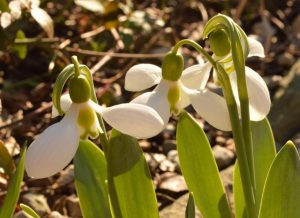
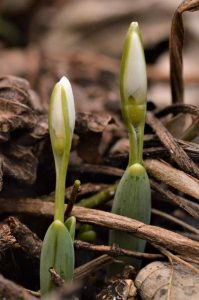 The most common species planted in Gardens, and very deservedly so I might add, is Galanthus nivalis. This species is also the type species for the genus, against which all species are evaluated and compared. This species was also named by Linnaeus in 1753, with the species epithet coming from the Latin meaning ‘of the snow’ or ‘snow-covered’. Typical to the genus, each bulb produces two linear leaves that ultimately grow to 6-8” long. The flower scape emerges from in-between the leaves when they are merely 1-2” tall as seen at left. The flower scape ultimately stretches to 6-8” tall as well and terminates in what appears like a shepherd’s crook, with the flower dangling from the center of the crook (see image below of Galanthus elwesii). When the flower initially emerges from between the leaves, the bud is held upright and is enclosed by a protective leafy bract or spathe. The spathe consists of two modified leaves called spathe valves and two transparent membranes. The spathe valves are located on either side of the flower bud and appear as slender green lines, as seen in the image above.
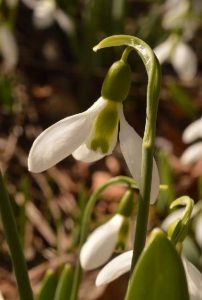 The two transparent membranes are connected to the spathe valves and wrap around the bud. As the bud expands, the membranes split open and fall away, while the 2 spathe valves elongate and curl downward, forming the ‘shepherd’s crook’, as the image of Galanthus elwesii depicts at right. As the spathe valves elongate, the flower bud transitions from an upright bud to a dangling flower, located near the center of the spathe valves. An incredible ‘dance’ and fun to watch evolve if time permits!
As is typical to all members of the genus, the flowers are composed of 6 white tepals. A tepal is an organ whose function is to attract pollinators, but there is no true distinction between the inner petals and the outer leaf-like sepals. The 3 outer tepals are usually pure white in color with a longer and more linear shape, although some seedlings have a more rounded form. They are convex in cross section and are roughly ¾” long for this species. Initially hanging downward, they flair outwards on warmer days, giving the flower greater presence and expose the three inner tepals to pollinators. The inner 3 tepals are bilobed at their tip, roughly 1/3 the length of the outer whirl and grow tightly together to form a central cone. Each inner tepal bears green markings, which vary by species. G. nivalis has a single green mark spanning the two lobes at the tip of the tepal. These markings not only act as nectar guides for pollinators, but are photosynthetic and aid in producing sugars for the production of seed. Snowdrops go dormant by late May. 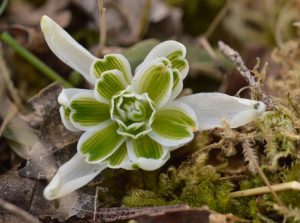 The compressed growing period pressures the genus to produce as many carbohydrates as possible for generating seed and developing new bulbs for the following year. Albeit small, these green markings aid in the production of the needed sugars! Interestingly, the foliage and tepals also contain small air-filled spaces that allow the flowers to tolerate subfreezing temperatures as they begin to bloom. The globe shaped ovary is located above the tepals, with the small black seeds maturing in mid to late May. The seeds have an attached lipid rich structure called an elaiosome, which not only feeds and attracts ants, but serves as a means of seed dispersal.
‘Flora Plena’ is one of several cultivars that has numerous additional tepals, producing a ‘double’ flower (pictured left). When viewed from above, the additional whirls of tepals gives the flower a fuller appearance, much like how a Hoop Petticoat impacts a dress. Unfortunately, the extra tepals also add weight to the flower, causing it to droop and the details of the bloom are not evident unless it is physically turned towards the viewer. It is also one of the last forms to bloom, typically still attractive and in color in April!
 Another readily available species is the formerly mentioned Galanthus elwesii. The plant resembles its cousin in all aspects except it is larger with the outer tepals reaching an inch or longer in length. They are often the first species to emerge and feature green markings on both the upper and lower ends of the inner tepals. They can even be connected, as seen at right. The larger outer tepals results in a flower upwards of 2” in diameter when fully open! The species honors the British botanist and entomologist Henry John Elwes (1846-1922), who came across a mass of large flowered Snowdrops in 1874 while botanizing in the mountainous regions near Smyrna, Greece. In 1875, the English botanist Dalton Hooker (1817-1911) honored Elwes with the species epithet. Interestingly, the plant that Elwes found was actually a previously described species named Galanthus gracilis and Hooker’s species name was used to describe another, as of yet unnamed large flowered species!
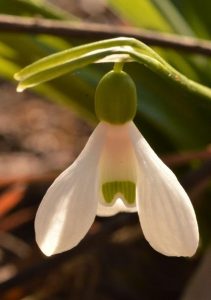 Another delicate and very attractive species is Galanthus ikariae. Named by John Gilbert Baker (1834-1920) in 1893, it is native to several Greek islands in the Aegean Sea, including the island of Ikaria for which it is named. If the island’s name sounds familiar, it is named after Icarus, who in Greek legend escaped from King Minos by fabricated wings from feathers connected by wax. When he flew too close to the sun, the wax melted and he fell to earth. Legend has it he was buried on this island that bears his name! This species bears smaller pendant flowers to 1” long and a single green mark on the tips of the inner, bi-lobbed tepals (pictured at right). Often, this green mark will extend half way or further up these tepals. The foliage is glossy and more attractive than the mat-green forms, growing to 6-8” tall. Not ideal for plugging into turf since the reflective foliage does not blend well with turf grass. In the wild, the plant is often found in river valleys, growing with Cyclamen hederifolium in deep humus rich soils. It has also been found in upland gravely soils in scrubby growth. The plant is somewhat less winter hardy, but I have not had any issues in over 30 years of growing the plant. Unfortunately, it does not appear to naturalize as readily as other species.
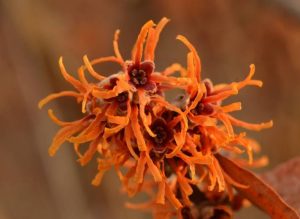
Snowdrops are an easily grown bulb, providing your garden is zone 7 or colder, since they resent summer heat. The challenge is often getting them established. Due to their smaller size, some of the bulbs desiccate before they arrive on retail shelves. The most successful time to transplant is while the foliage is still green and they are in active growth! All the species enjoy well-drained soils and thrive in full sun or in locations beneath deciduous trees. Plant to a depth of three times their diameter or around 3” deep. They are best planted in random groups with 3-6 per hole to provide a more mature appearance. Consider interplanting among deciduous shrubs such as early blooming Quince (Chaenomeles) and Witch Hazel (Hamamelis), or at the base of Red Stemmed Willow (Salix alba ‘Britzensis’). Or plant in turf, providing you can wait until the second week of May to make the first cut, allowing for the foliage to go dormant before it is cut.
Snowdrops are a remarkably easy and rewarding bulb for your garden, typically the first bulb, or if I may, geophyte to awaken in the NJ garden. I should also mention the vast number of unusual Snowdrop selections available from specialty nurseries with unique green or yellow markings. These selections can drain the checking account, yet in moderation they will enhance your appreciation for this plant! Whether ordering bulbs next fall or plants this spring, Snowdrops will delight you for years to come as they start your spring symphony of garden color.
Bruce Crawford
Program Coordinator for Home and Public Horticulture (NJAES)

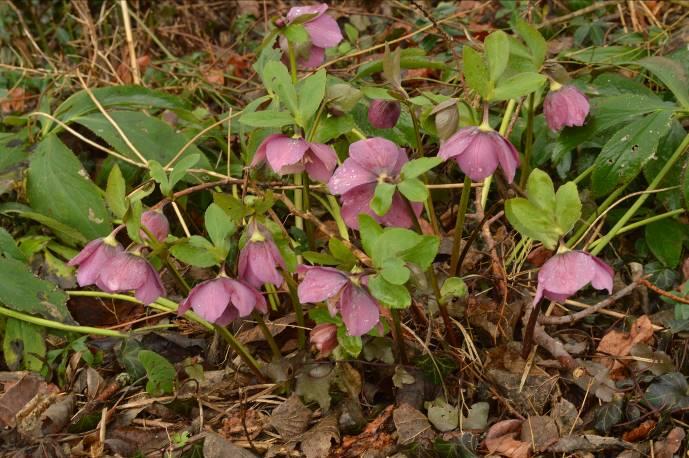
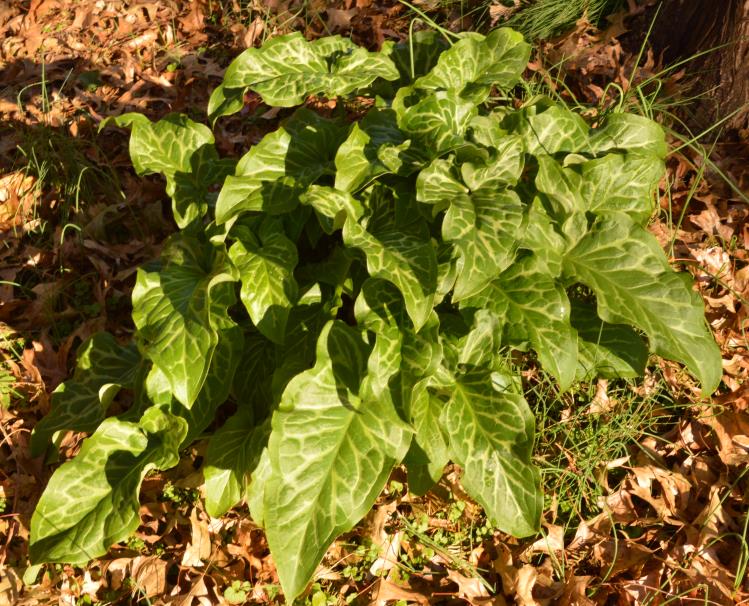 With the chilly temperatures of winter well entrenched in our Gardens, evergreen foliage clearly plays an important role in providing interest at this time of the year. Conifers serve an important role in providing the bones for the garden, but there is still a need for detail plantings as we walk about our walkways and paths. One plant I have enjoyed using over the past 30 years for winter foliage and form, as well as for its ‘hot’ flowers come spring is the Italian Arum, Arum italicum.
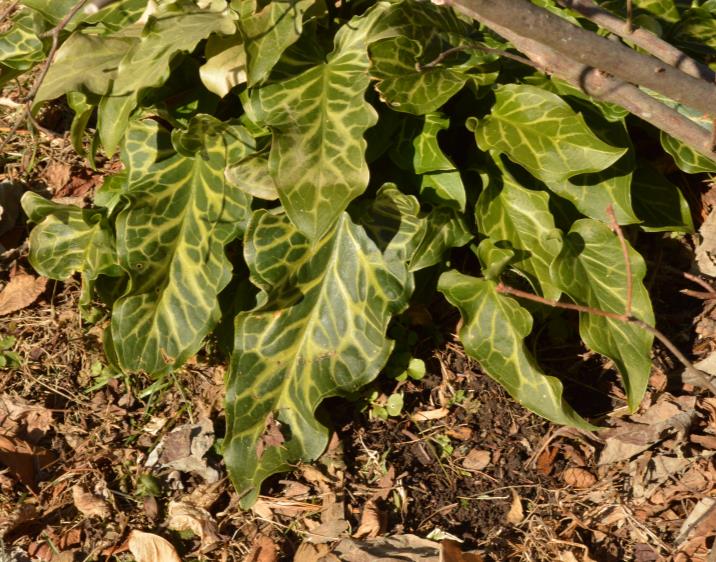 Typical to the genus, Italian Arum grows from a tuber, with the sagittate or arrow-shaped foliage beginning to emerge in late September or early October and typically remaining attractive until the following June (photo at right was taken on February 10th). During severe winters, the foliage can scorch if located in an exposed location, but fret not as it will be refreshed with new foliage come spring. The straight species features glossy, deep green foliage or foliage with white splotches while the previously mentioned subspecies is laced with white venation. The leaves usually grow to 12” tall by 6-8” wide, but can be larger if conditions are ideal. The foliage certainly provides great winter interest, but come spring, it is the flower that makes the plant all the more fascinating!
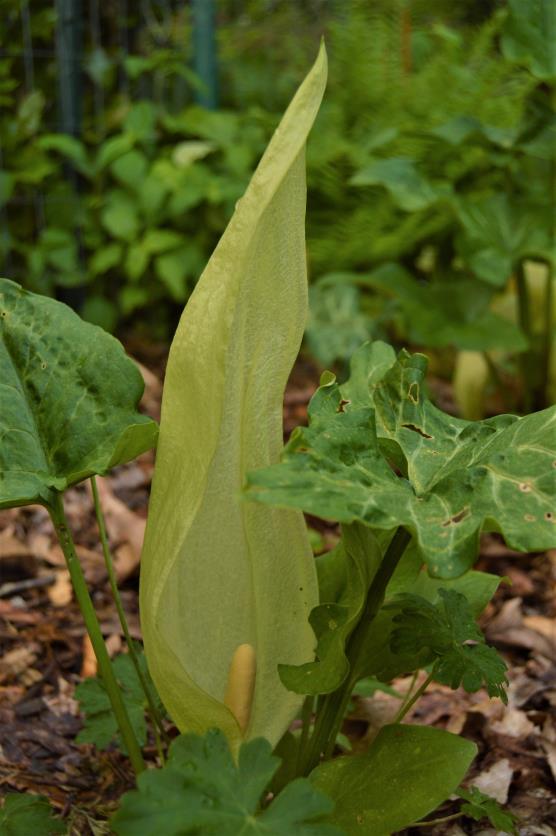 Arum flowers are termed protogynous, whereby the female flowers mature first and are no longer receptive to pollen when the staminate flowers mature and begin to release pollen. This staged maturation prevents the flowers from self-pollinating, resulting in inbreeding depression. To further aid in pollination, the male flowers are thermogenic, whereby they actually go through periods of releasing heat and can become upwards of 50 degrees warmer than the ambient air! Initially, this makes little sense, until one realizes that the flowers are pollinated by flies and the heating of the flowers releases volatile chemicals that smell like rotting meat or even stale urine! None to worry though, since the odors are too faint to be noticed by the passing gardener. Attracted by the odor, small flies are able to push past the filaments of the staminode flowers in search of the source of the odor but, due the slightly downward orientation of the filaments, the flies are not able to escape. The filaments remain resilient against any attempts of escape for around 24 hours, allowing the incarcerated the flies to hopefully deposit pollen from a previously visited flower onto the stigmas. After one day passes, the stigmas become unreceptive to pollen while the staminate flowers begin to shed pollen and the staminode filaments become limp, allowing the pollinators to collect pollen as they move upward and out of the spathe tube. An incredible scenario!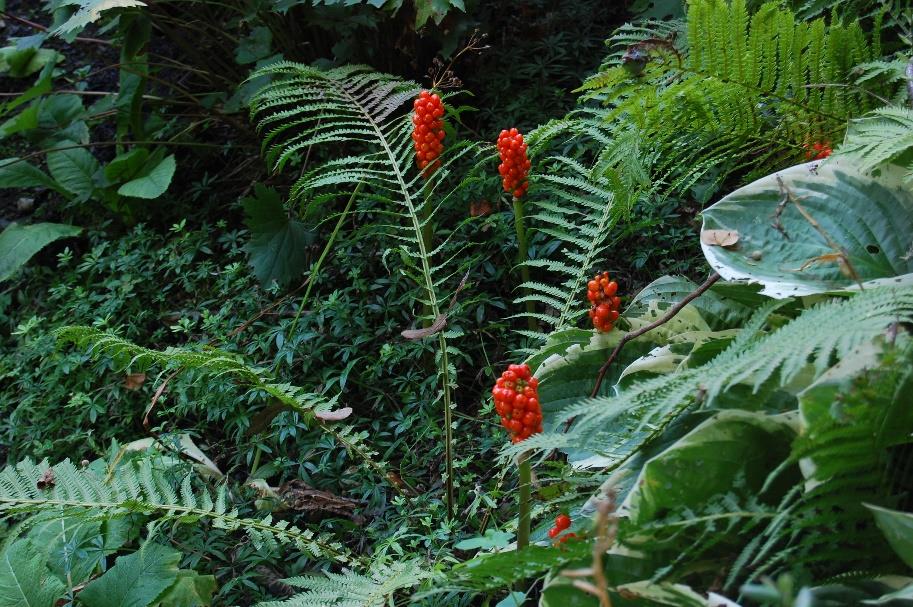
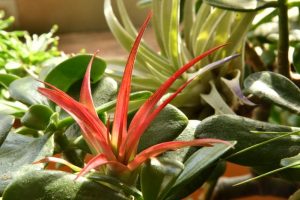
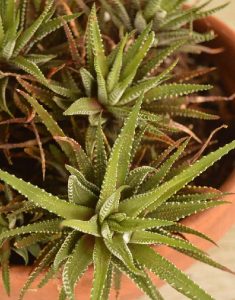 botanist and entomologist Adrian Hardy Haworth (1767-1833) who described 21 species of the genus throughout his career, although he too classified them as Aloe! In 2013, based upon genetic studies, the British botanist Gordon Douglas Rowley (1921-2019) split the genus creating the new genus of Haworthiopsis. The new ending for the name is from the Greek Ópsis for appearance, indicating these plants appear like Haworthia. The most noticeable physical difference is the thicker and harder epidermis or outer covering of the Haworthiopsis leaf when compared to Haworthia. Both Haworthia and Haworthiopsis are native to countries in the southern regions of Africa with the predominance of species found in South Africa, although Mozambique, Swaziland and Namibia are also home to numerous species. Both genera exhibit CAM or Crassulacean Acid Metabolism whereby the leaf stomata open only at night to reduce the loss of water during the day and allow for gas exchange. This allows the plant to be very efficient at conserving water, but also rather slow growing since it can only produce a limited amount of sugars per day based upon the amount of CO2 absorbed at night.
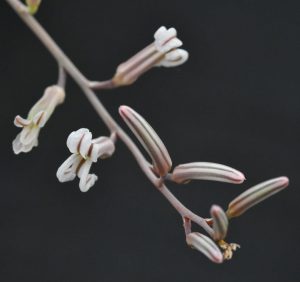 The most commonly grown species, and the plant my mother used with seemingly reckless abandon is the Zebra Cactus or Haworthiopsis attenuata (pictured at right). The species epithet is from the Latin Attenuatus meaning diminished or lessened and refers to the form of the leaf, which tapers or diminishes to a sharp point. The common name of Zebra Cactus comes from the ornamental bands of small white warty projections called tubercles on the back sides of the dark green leaves, which with a touch of imagination resemble the markings of a Zebra. The tubercles allow the expansion of the leaf during the moister summer months without imparting any tearing or damage to the stiff epidermis of the leaf. The plants are stemless and produce 3-6” diameter rosettes of foliage that develop offsets or pups over time and eventually develop into sizable colonies. White to soft pink flowers are occasionally produced during late fall and winter, which corresponds to the spring and summer months in the plants native homeland. The genetic clock does not change simply because the plants are now in North America! The flowers are located along slender stems that bend like fishing poles under the weight of the flowers. The flowers actually consist of tepals, whereby the petals and the leafy calyx look identical and they are displayed in a bilobate arrangement, with a very distinguished upper and lower lip, as seen above. The tip of the lips reflex back, giving the flower a very pronounce appearance similar to a set of puckered lips. Green or reddish brown stripes run down the inside and outside of the flower and most likely serve as nectar guides or visual cues for visiting pollinators.
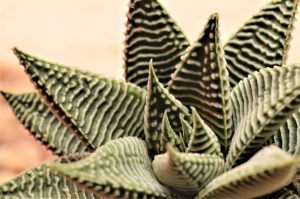 Another very ornamental species is Haworthiopsis limifolia, commonly called the File Leafed Haworthia or Fairies Washboard. Herman Wilhelm Rudolf Marloth (1855-1931), a German born South African botanist and pharmacist, described the species in 1910, under the genus Haworthia. The epithet is from the Latin limo, meaning to diminish or file off, a reference to file-like appearance of the raised linear ridges of tubercles along the leaves. The common name of Fairies Washboard is also a reference to the raised ridges of tubercles. The leaves are arranged in stemless rosettes, although they are slightly broader, especially near the base when compared to its previously mentioned cousin. ‘Spider White’ (pictured above) is a relatively recent introduction with very white tubercles and is the recipient of the 2015 Dutch ‘Glass Tulip’ award for best new houseplant. The tubercles are a very showy white and give the foliage a very attractive creamy glow!
 summer months, the plants are actively growing and are tolerant of our summer rainfalls, allowing them to be used in summer container arrangements or simply set outside for the summer. In the regions where they are native, they typically grow in the shadow of a rock and prefer a similar, lightly shaded location as an ornamental. Fertilize with a half dilute houseplant food that has a higher phosphorus content, such as 5-10-5. Come fall bring the plants inside and give them a windowsill with bright light or morning light. The key in winter is to let the soil dry out completely in-between watering, which can mean upwards of 2-4 weeks without the need for a watering can – something that may prove very difficult for some gardeners!