

The Garden Club of New Jersey

Supporting Our Local Garden Clubs

member login contact us join a club
  • Home
  • Awards
  • Events
    • Calendar
    • Meetings & Events
  • Forms
  • Projects
    • Backyard Wildlife Habitat
    • Blue Star Memorial Markers
    • Butterflies and BeeGAP
    • Natural Disasters Fund Application
  • Membership
    • Benefits
    • Affiliate
    • Insurance
    • Incorporation
    • Life Membership
  • Publications
    • News Leaf
    • Central Atlantic Region of State Garden Club News
    • National Garden Clubs News
  • Scholarships/Grants
  • Schools
    • Environmental School
    • Flower Show School
    • Gardening School
    • Landscape Design School
    • Symposium
  • Youth
    • GCNJ Youth Contests
  • Resources
    • Crawfords Corner
  • Shop

Welcome to Crawford's Corner!

If you have further questions, please write to Bruce at Crawford@njaes.rutgers.edu

Plant of the Month for October 2020 – Salvia

October 1, 2020 By Bruce Crawford

Salvia – A Sensational Plant for Autumn Color

October is the month that truly evokes autumn. The temperatures are starting to cool, the foliage has started its autumn symphony of colors and many of the summer annuals are now looking tired. This is the time when gardeners truly need a new plant palette for late season color. Although Salvia, commonly called Sage, is typified in NJ by summer blooming annuals, some of the species and cultivars really begin to shine in autumn, and Salvia leucantha or Mexican Bush Sage is among the best!

Salvia is the largest member of the mint family or Lamiaceae containing close to 1,000 species of shrubs, herbaceous perennials, biennials and annuals found throughout Central and South America, Eastern and Central Asia and the Mediterranean. The genus name was first used in the writings of Pliny the Elder. Born as Gaius Plinius Secundus (23-79AD), he was a Roman general who studied plants and natural environments throughout his military expeditions. The genus stems from the Latin Salvere, meaning to feel healthy. He was most likely discussing the culinary Sage, now known as Salvia officinalis that had long been renowned for its healing and health virtues. SalviaThe common name of Sage also originated from the word Salvere, which transitioned to the Old French Sauge, and later to the Middle English Sawge before finally becoming the word we know today! The Swedish botanist, Carl Linnaeus (1707-1778) officially named it Salvia officinalis in 1753. It is also the ‘type’ species for the genus, to which any new or existing species are compared. The species epithet officinalis was a term that Linnaeus originally coined in 1735 and used repeatedly throughout his career. It stems from the Latin officina, which initially meant workshop or place of work. It transitioned to the name of a storage room in monasteries where medicines and medicinal plants were stored. Officinalis means ‘belonging to an officina’ and Linnaeus affixed this epithet time and time again to describe plants or animals that were known to have medicinal benefits.
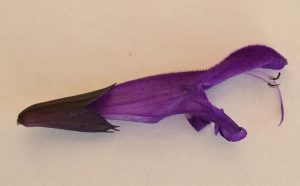
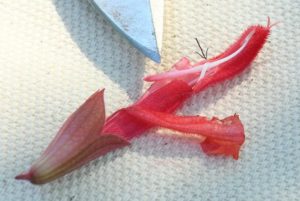
Salvia flowers come in a multitude of colors, ranging from red to white to various shades of blue and indigo. Often the calyx or leafy bracts at the base of the flower are darker in color as seen above in a flower of Salvia ‘Amistad’, which adds to the ornamental appeal. The size of the flower also varies from ½” to nearly 3” in length. The flowers are also much beloved by pollinators but, what remains hidden from casual observations is the rather unique mechanism for ensuring pollination. The corolla is a combination of all the petals and Salvia petals are divided into a large overarching upper corolla lip and what appears like a pollinator landing pad for a lower lip, as seen in the image above. Both the long thread-like stigma that receives the pollen and the anthers that shed pollen are located within and protected by the arching upper corolla lip. What makes pollination unique is how the anthers became modified over time to ensure pollination. Anthers consist of a slender threadlike filament that is attached to the base of the flower with typically two pollen releasing structures at the apical or tip of the structure called theca. The theca are actually connected to a small horizontal structure called a connective, which in turn is joined to the tip of the filament. SalviaIn most plants the connective is so reduced in size that the theca appear to be attached directly to either side of the filament. In Salvia, it is speculated that the anthers became reduced from an initial count of 4 to 2, while the connective became elongated, pushing one theca closer to the tip of the upper calyx lip and the other, nonpollen bearing theca, deeper into the base of the flower. Over time, the lower or basal theca lost their ability to generate pollen and joined together, producing a wishbone shaped structure that pivots on the tips of the two filaments. In the image above of Salvia Embers Wish™, the lower lip of the corolla was cut, exposing the nearly white connectives and filaments that are attached to the lower corolla. The knife tip is pointed to the lower, non-pollen bearing theca. The arrow points to the filaments, upon which the connective pivots. At the very base of the flower are the nectaries that are laden with a sugary liquid, which the pollinators naturally wish to reach when visiting the flower. When the insect or bird enters the flower or pushes in its beak to reach the nectaries, it hits the bottom end of the wishbone structure, allowing the two pollen releasing theca to pivot down upon the back or head of the visiting pollinator. After several days, the anthers finish releasing pollen while the two stigma that are seen protruding out of the front of the flower above, become receptive to pollen and lower, brushing across the back of the visiting pollinator and collecting the pollen deposited from a previous flower. Thus, the sacrifice of the two theca to create this pivoting wishbone structure actually enhanced the chance of pollination rather than diminished. In addition, with the anthers and stigmas ripening at different times, the flower will not ‘self-pollinate’, since crosspollination creates more vigorous offspring. Ingenious!
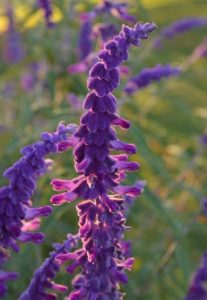
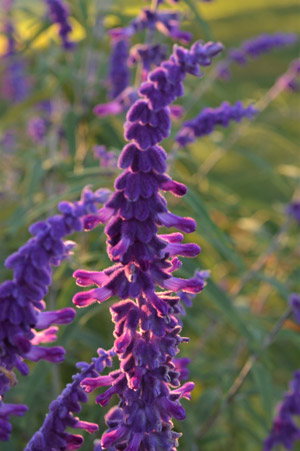
salviaAlthough many summer blooming forms of Salvia are still in bloom come October, one of the best species for autumn is Salvia leucantha, commonly called Mexican Bush Sage. It is native to central and eastern areas of Mexico that feature tropical and subtropical weather conditions. In February of 1791 it was named by the Spanish botanist Antonio José Cavanilles (1745-1804), who was one of the first botanists from Spain to appreciate and accept Linnaeus’ concept of genus and species. Leucos is Greek for clear, white or pale, and Anthos is Greek for flower, describing the white flower that is subtended by a velvety purple calyx. As the weather cools, the flower color deepens to a light lavender in color, as seen in the image at right that was photographed in early November. The plants mature to 2-3’ tall and wide, with the arching, 4-6” long flowering racemes beginning to appear in late August and continuing until heavy frost. The 3-4” long leaves are oppositely arranged and much like the calyx, they are also slightly pubescent. Like all the species of Salvia, Mexican Bush Sage prefers full sun and well-drained soils and thanks to the scented foliage, it is also deer resistant. It also makes a superb container plant and is an excellent substitute for Chrysanthemums should you be looking for something different.

The various cultivars and species of Salvia remain a very popular addition to summertime gardens, but gardeners often overlook the late summer and autumn bloomers since they lack flowers when most people are buying plants in May or June. When considering the autumn garden, look to adding this spectacular annual to your garden. Spectacular for adding late-summer through November color to the Garden, for its interesting pollination strategy and for its ease of culture! This is a Salvia that most certainly belongs in your garden!
salvia

Bruce Crawford
Program Leader in Home and Public Horticulture, NJAES
Gardening Notes for September

September 4, 2020 By Bruce Crawford

September marks the start of getting the garden – and the gardener – ready for a long winters rest. To this end, consider how best to overwinter and to make room for your favorite non-hardy plants indoors, as well as considerations for your outdoor hardy plants and any new plantings. Fortunately, we still have several months remaining for plants to grow, so there is no rush! Continue to take good notes and pictures on how you weaved together your perennials and annuals this year, since after the first frost these pictures will be all that remains of this year’s favorite combinations!

Things to do:

  • Continue to keep your lawn mower blades set high for cutting your lawn. Rain has been ample, although rather sporadic. The temperature look to be average or cooler for the start of the month, which will minimize the stress on the turf.
  • September is a great time for the reseeding of bare spots, or for the installation of sod. The upcoming cooler temperatures, heavy dews and typically consistent autumn rainfalls combined with warm soil temperatures promotes good root growth and turf establishment.
  • September is a good time to fertilize your lawn. If you wish to fertilize once a year, September is an ideal time as it aids in developing a good root system throughout the winter for next summer’s heat.
  • September is a good time to aerate those portions of the lawn that receive excessive foot traffic or have otherwise developed compacted soils.
  • If you have yet to start, take cuttings of your favorite annuals that you wish to overwinter. It will be ready to be potted-up in 4-6 weeks. It is far easier to over-winter a small plant that should be free of most insect and disease than lifting a large plant from the ground or outdoor container and bringing it inside.
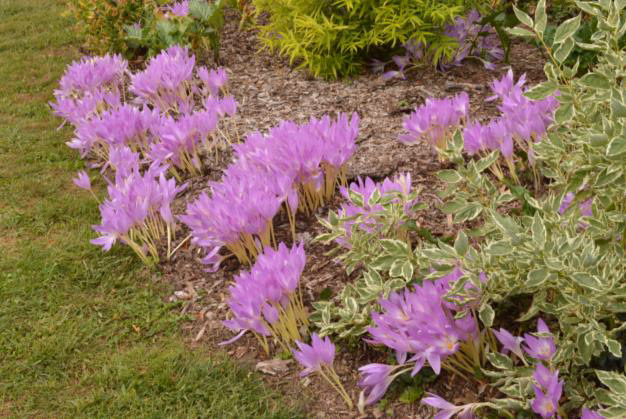
  • Colchicum

  • Harvest and clean the seed from those annuals and vegetables that come true from seed. Allow them to dry and store them in small paper pouches that are properly labeled and place them in the refrigerator (not the freezer) until next spring.
  • Remove those annuals that look excessively tired or leggy and keep removing annual weeds such as crabgrass and stilt grass. Annual weed seed will continue to germinate and appear as long as the temperatures are warm. Remember, on average a seed lasts for seven years and one plant going to seed equates to seven years of additional work!
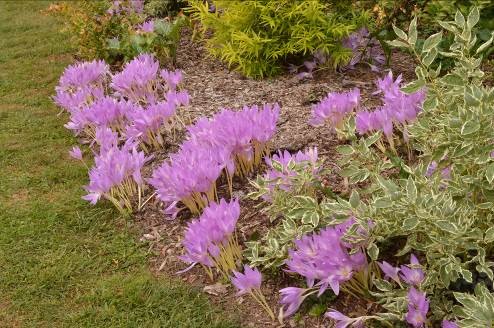
  • Send in your bulb orders! October is a great month for planting bulbs. For Colchicum (Pictured at right), get in your orders in early September or look for them in your favorite garden center. They bloom in late September into early October with typically pink or white flowers and they are deer resistant!
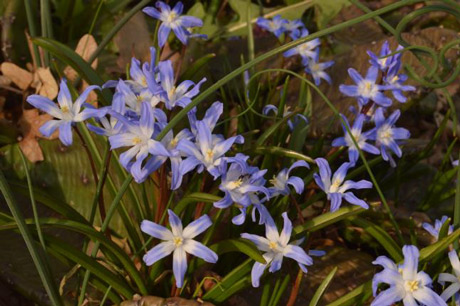
  • As a reminder, don’t order just 6-12 bulbs if you are looking to make an impact. For minor bulbs (bulbs that measure close to ½” in diameter), you typically need 50-100 bulbs to begin to make an impact and obviously, the more the better. These bulbs include Snowdrops (Galanthus), Squills (Scilla) Grape Hyacinths (Muscari) and pictured below, Glory of the Snow (Chionodoxa) species. For major bulbs, such as Daffodil (Narcissus), Tulip (Tulipa) and Flowering Onions (Allium) species, 25 to 50 bulbs will make an impact on the Garden.
  • Chionodoxa

  • For both major and minor bulbs, I like to cluster several bulbs in a hole to create a more mature appearance. For minor bulbs, clusters of 3-8 work well while for major bulbs, clusters of 3-4 give a more mature appearance from the start. These are all things to keep in mind as you put together your bulb order!
  • Inspect and evaluate your ornamental small trees, shade trees and shrubs. Even though it has been a relatively moist summer, those plants that are stressed from age or disease will let you know through early leaf wilt or drop. Oaks that have Bacterial Leaf Scorch will have leaves that suddenly turn brown in mid to late August. There are treatments for this disease, but once most of the foliage has turned brown the tree will ultimately need to be removed. It typically attacks older, less vigorous trees and young oaks should still be planted, since the trees feed over 500 native insects!
  • September is an ideal time to add woody and herbaceous plants to the garden. The soil is warm and although it is often a relatively dry month, the cooler days and moister weather ahead will allow the plants to establish an adequate root system before next summer’s heat and potential drought. Woody plants that are not fall transplant hazards can be dug and transplanted, and those that are fall hazards can be planted if they were dug this past spring or grown in containers. If rainfall is scarce, water new plantings every 3-4 days through the end of October.
  • For the vegetable garden, continue to remove plants that are no longer producing. The wet weather of July and early August raised havoc with tomatoes as the fruit is subject to splitting and cucumbers faded from Powdery Mildew. As mentioned last month, Dr. Bob Mellert mentioned that the days to maturity on seed packets applies for springtime seeding. Come autumn, the number should be multiplied by 1.5 to account for the slower growth time due to the shortening days as compared to the lengthening days of spring. Plant leafy crops that appreciate the cooler nighttime temperatures, such as Arugula, Spinach, Bok Choi, Kale and Lettuce. The full list is below:
  • Root Crops
    Beets (45-64 day)
    Carrots (65-80 day)
    Fennel, Bulbing (72)
    Scallions (60 days)
    Kohlrabi (45-60 days)
    Radishes (21-48 days)
    Leaf Crops
    Lettuce (45-55 days)
    Mache (like lettuce) (40+)
    Mesclun Mixes (30-40 days)
    Bok Choy (45 days)
    Salad Greens (28-42 days)
    Spinach (45 days)
    Chard (28-42 days)

    Other
    Broccoli (55-80)

  • If you are planting in containers, consider the leafy crops like Spinach and Bok Choi. They will provide well into the beginning of winter.
  • low tunnels

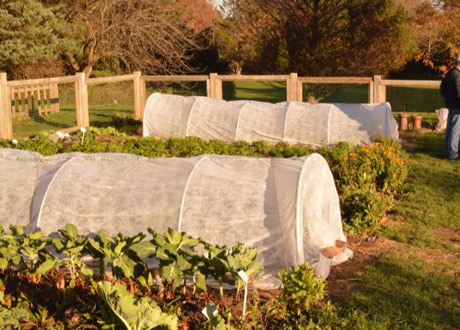
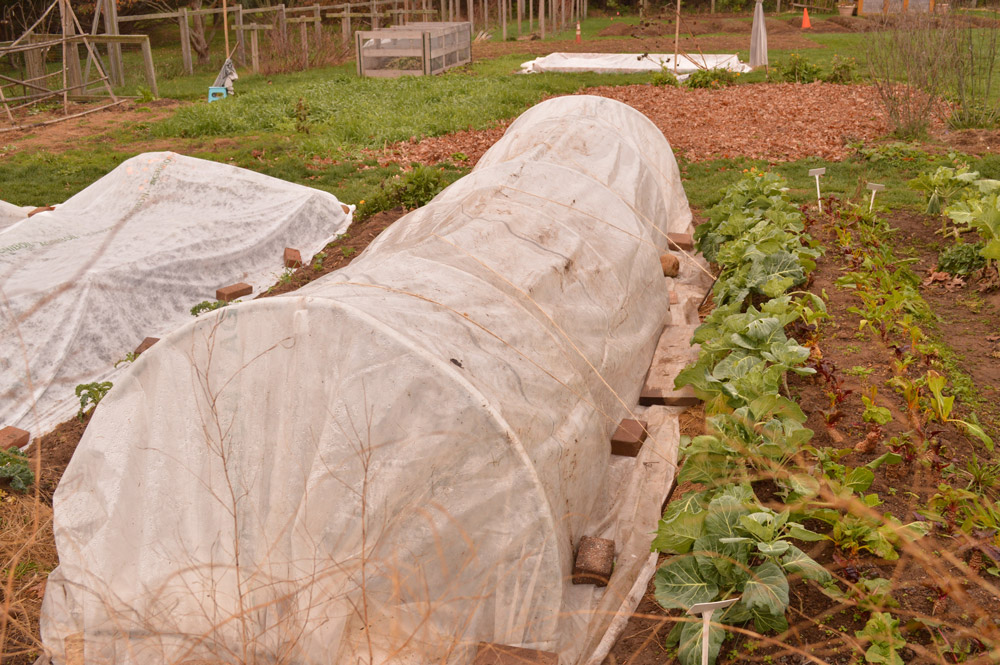
  • Consider the installation of low tunnels, as seen at right, which are metal hoops covered with a fabric called Agribon. The fabric keeps heavy frosts off a row of cool season vegetables. It enables the gardener to harvest well into December, and for certain crops, into spring! September is a good month to pick-up the materials needed to construct the low tunnels.
  • September is an opportune time to plant garlic too! ‘Music’ is an old fashioned favorite and a good performer, but try some of the many other selections that are on the market too! Plant in a location that will be in full sun through next August, which is the harvest period.
  • If you live with large deer populations, put wire cages around recently planted trees to avoid the bark being rubbed and damaged by bucks. One of their favorite targets are Magnolias, so make certain that they are properly protected. Damage to bark is far more harmful than the nibbling of a few leaves and I have lost many a tree before we start installing cages.

Bruce Crawford
Program Leader, Home and Public Horticulture (NJAES)

Plant of the Month – September 2020 – Helianthus

September 4, 2020 By Bruce Crawford

Helianthus: A Plant with a Sunny Disposition

The autumn months are synonymous with fresh apple cider, donuts and for the garden, Chrysanthemums. I enjoy the many varieties and colors of Chrysanthemums and, aside from a few very hardy selections, I find them to be more ideal candidates for containers than additions to the Garden beds. This then begs the question of what to plant in the Garden? Finding colorful plants for September into October is often a challenge, since many have already completed their bloom. Yet, there remain some great plants and one plant that has consistently amazed me for its sunny impact and length of bloom is the Swamp Sunflower, Helianthus angustifolius.

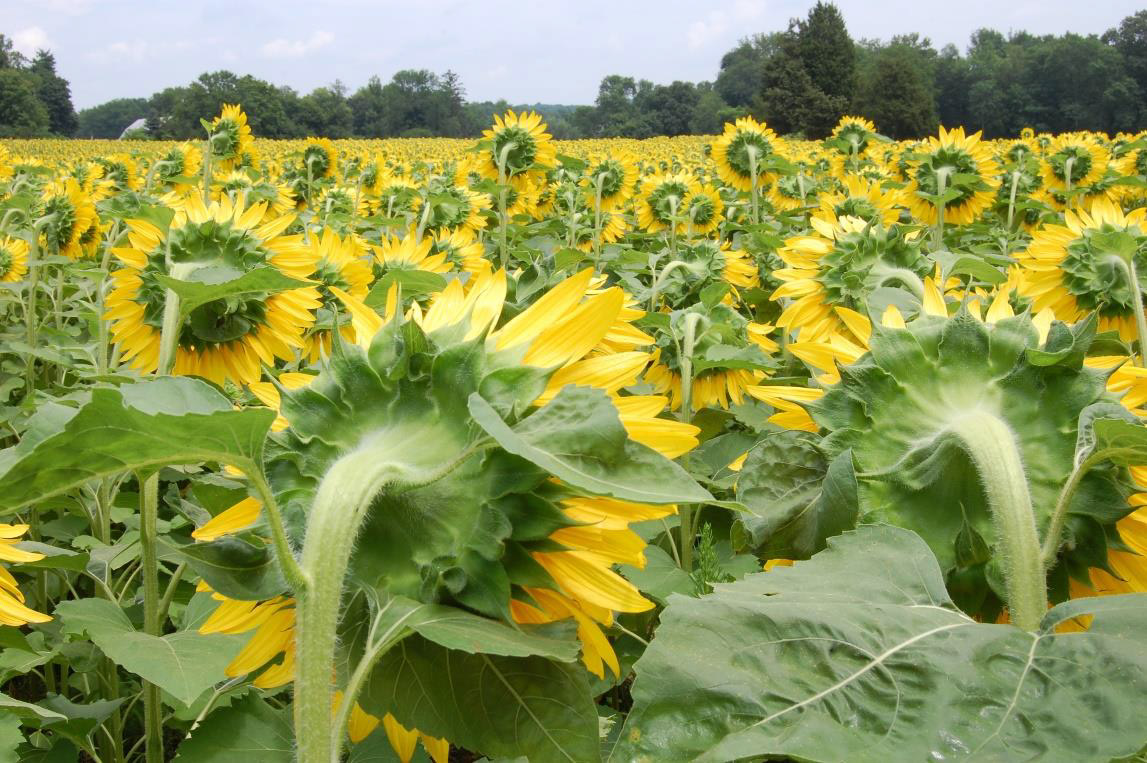
Helianthus is in the Asteraceae or Aster Family and, with over 1,900 Genera and 32,900+ species, it would make one very large family gathering at Thanksgiving! In fact, Helianthus alone has over 70 species. The genus name was penned by the Swedish Botanist, Carl Linnaeus (1707-1778) in 1753 and is derived from the Greek Helios for sun and Anthos for flower. The botanical and common name of Sun Flower stems from the heliotropic nature of these plants, whereby the flower is able to move and follow the sun as it tracks Westward throughout the day (as the field of Sunflowers depict on the last page). The plants developed this ability to maintain the maximum reflectivity of the flower and heightened ability to attract pollinators. In Greek Mythology, this diurnal movement prompted the story of the water nymph Clytie who was infatuated with the sun god Apollo. For nine days she stared up at him as he traversed the sky. Without food she withered away and turned into a Sunflower, continuing to watch his daily travels for all of eternity!

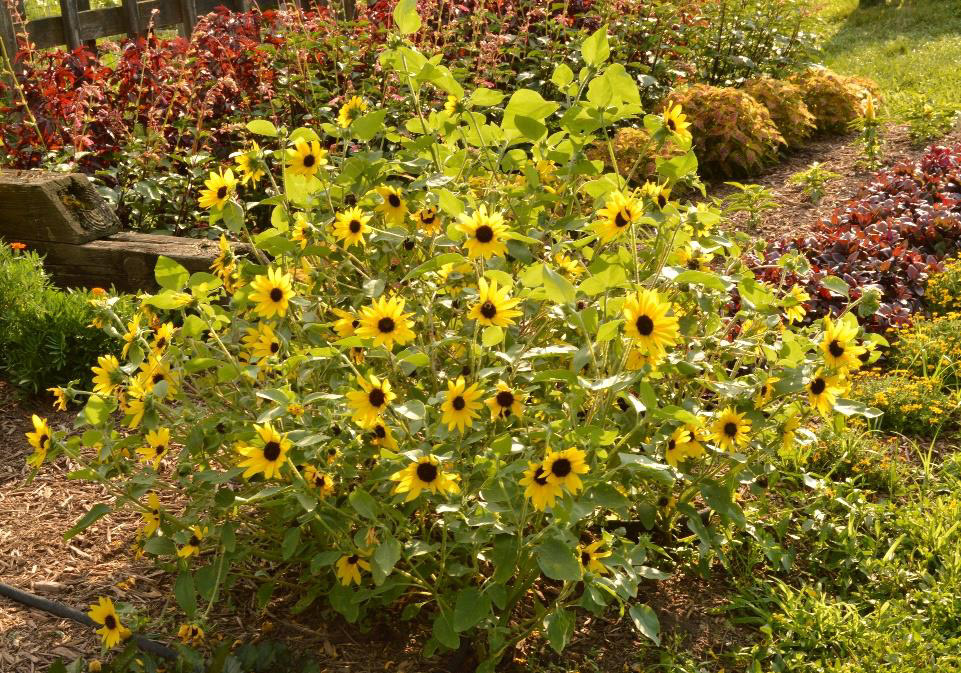
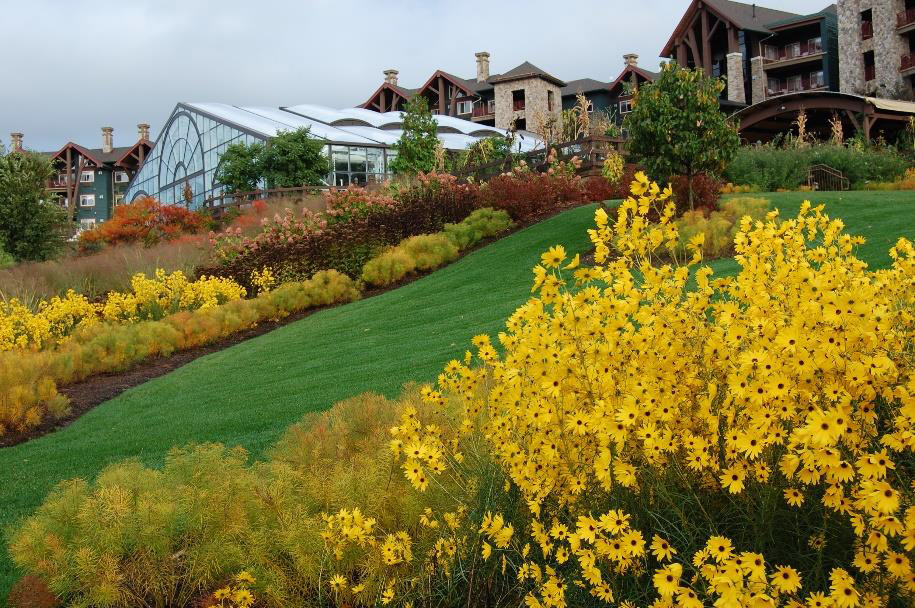
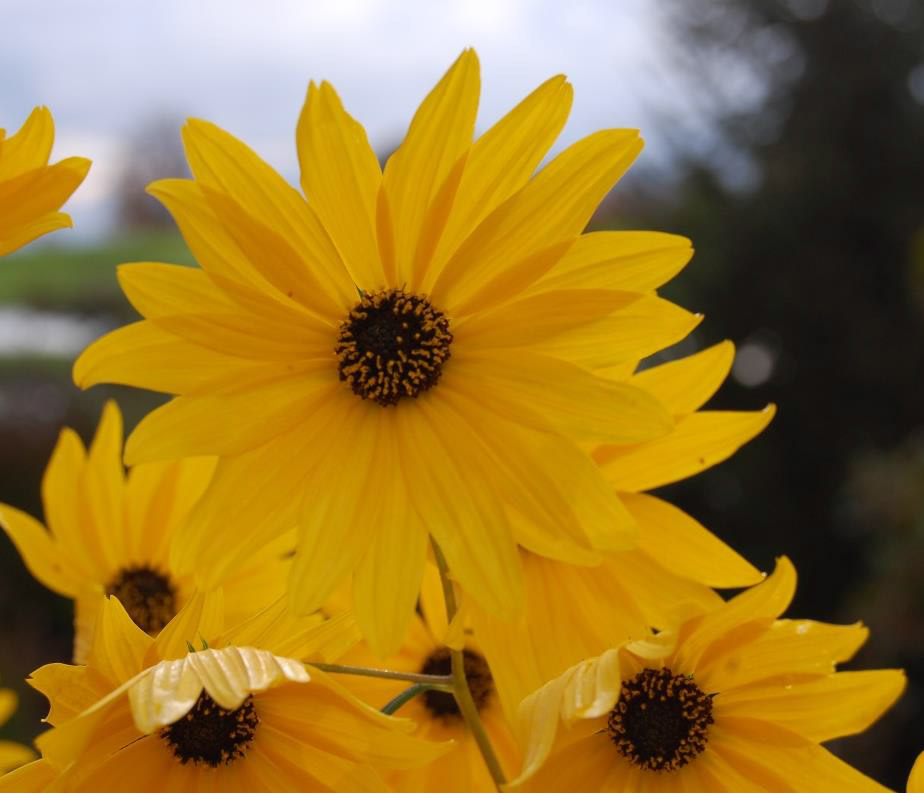
The type species or the plant by which the remainder of the species are compared is Helianthus annuus, the Common Sunflower. As the species epithet implies, it is an annual and is found throughout Western North America south into Northern Mexico. Seed hardy from zone 2-11, the coarse textured plant with pubescent stems and leaves rapidly grows to 5-10+ feet in height. The flowers have a whimsical quality and make for a very popular cut flower. Most of the hybrids produce one large flower, upwards of 12” in diameter per stalk, but if allowed to reseed, the seedlings are typically multi-branched with a number of smaller flowers. This plant has found multiple uses aside from ornamental, with the fruit being used for oil and food, and the birds love the fruits whether from a bag or right from the flower! Plants prefer full sun and well-drained soils. Recently, a more compact hybrid has come on the market called ‘Sunfinity’ (pictured below, left). It displays a more compact habit to 3-4’ tall and wide, with a continuum of 3-4” diameter flowers from June through September or early October. By comparison, the Swamp Sunflower (pictured at left at Crystal Springs and an individual flower ,right) is a long-lived perennial that prefers moist or water retentive soils and is native from Texas, northeast to Long Island. Also named by Carl Linnaeus in 1753, the species epithet is from the Latin angust for narrow and foli for leaf, describing the narrow leaves which can reach upwards of 6” long. The stout stems typically reaching 5-7’ tall with a spread of 4-6’.

sunfinity
swamp sunflower

One of the interesting aspects of the Asteraceae is the misleading appearance of any given ‘flower’. The word Aster is from the Greek Astēr, meaning star. It is a reference to how the flowers have a star-like center with the ‘petals’ resembling the emanating rays of sunlight. In reality the flower is composed of not one, but 100’s of small, individual flowers! This family was originally called the Compositae, since the ‘flowers’ consist of a composite of many small flowers or florets. The light rays along the edge are ironically called Ray Florets and the circular flowers that compose the central star are called disc florets. The flowers open or mature from the outer edge inwards, with the Ray Florets opening or maturing first and the central disc florets last. All the florets are attached to a plate called a receptacle and the entire structure is called a flower head or capitulum. The showy outer ring of ray florets is typically 3 petals fused into one, strap-like ligule, whose function is to attract the pollinators. Depending on the genus, the ray florets can be sterile or fertile and bare seed. The central disc florets are circular in shape with 5 fused and severely reduced petals. In place of the typical calyx or leafy bracts that subtend the petals, there exists a thread-like structure called a pappus that ultimately aides in the dispersal of the seed. In dandelions, the parachute structure that allows the seeds to magically float about is the pappus. In Helianthus, the pappus matures into two scales that fall off when the fruit is mature. The florets sit upon an ovary which develops into a fruit called a cypsela. Often considered to be an achene, a cypsela and an achene are very similar in that they are both a dried fruit that contains a seed. The difference being a cypsela develops from a double ovary, while an achene develops from a single ovary. In both instances, only one seed is produced. Hence, when you are eating sunflower seeds, you are actually splitting open the dried husks of the fruit, allowing you to get to the edible inner seed!

sunflower

For Swamp Sunflower, I have found it best to site the plant in a location that receives adequate moisture. After planting them several times in more well-drained location, the planting that has proven most successful over the past 10 years is at the base of a hill where it receives all the stormwater sheet flow from above (as seen above at Crystal Springs). The 2” diameter yellow flowers bloom profusely from late September through October and they look beautiful against the clear blue autumn skies. The plants look great paired with Winterberry Holly (Ilex verticillata), Blue Star Amsonia (Amsonia hubrichtii), Limelight Hydrangea (Hydrangea paniculata ‘Limelight’) and even the now drying stems of Joe-Pye Weed (Eupatorium purpureum). The plants are also a host plant for the Silvery Checkerspot Butterfly and the seeds are much beloved by songbirds, Ruffled Grouse, Quail and Morning Doves. Consequently, it is best to leave the stems up through the winter months.

A champion plant for our native pollinators, Helianthus angustifolius remains an uncommon plant in many gardens, which to me defies logic. Easily grown, long-lived with a very sunny disposition, this is a plant for autumn gardens!

Helianthus angustifolius
Bruce Crawford
Director, Rutgers Gardens

Gardening Notes for August 2020

July 31, 2020 By Bruce Crawford

To me, August is the month that epitomizes summer. The days remain long, with the daytime chant of the cicadas with the evening chorus of the crickets. Rainfall in July varied by where you live, but the high temperatures coupled with the generally lower rainfall is showing stress on some plants. August typically has many humid days, but the temperatures are usually in the 80’s, which is good for both the plants and the gardener! Remember to get outside during the cool of the morning or evening, use sunscreen and continue to take good notes of your endeavors.

Things to do:

  • Continue to cut the lawn as growth and rainfall permit. Maintain a higher cutting height of 3”+ to reduce the stress on the turf.
  • The third and fourth weeks of August are the ideal time for reseeding or seeding new turf areas. The evening dew becomes heavier and helps to ensure proper growth and the warm soils allow proper root development before winter. Supplemental irrigation will be necessary if rainfall is light.
  • Make certain plantings from this spring as well as trees planted last year continue to receive weekly irrigation during periods without rainfall. Remember, for a newly installed tree, every inch of caliper size (the diameter of the trunk 6” above the soil) will equate to 1 year of additional care and watering. Hence, a tree with a 3” caliper will require 3 years of additional care.
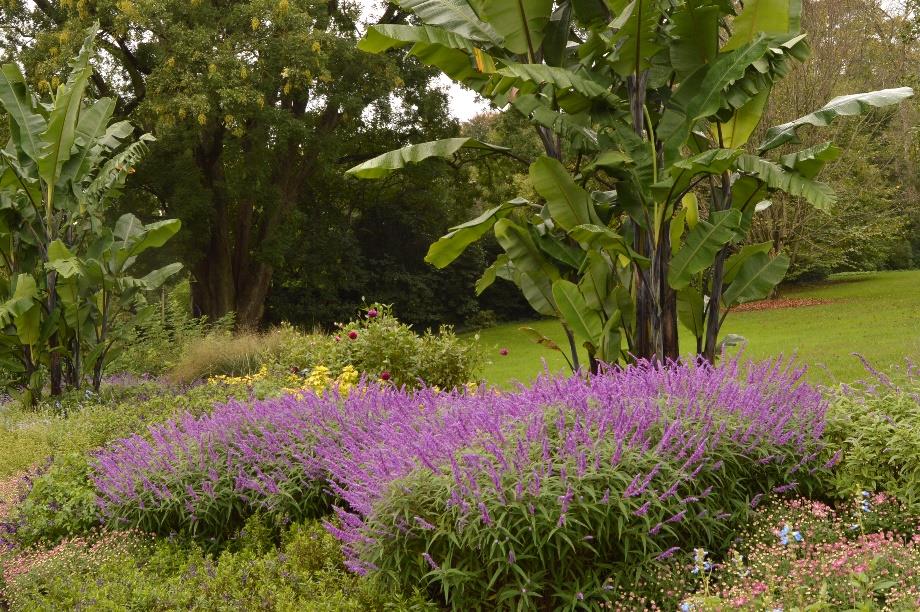
  • Mexican Bush Sage

  • Many annuals in containers may begin to look tired. For some, a light pruning with a weekly fertilizing and daily watering will breathe in new life. For others, it is simply time for replacement. For autumn, consider Salvia leucantha (Mexican Bush Sage, pictured at right) and Leonotis leonurus (Lion’s Ear) as alternative options to the garden ‘Mum’.
  • Although frost is still 2 months away, at months end you may wish to start taking cuttings of some annuals for rooting, potting and over-wintering for next year’s garden. If your rooting efforts fail, there is still plenty of time to get new cuttings.
  • Gather and save seeds of various non-hybrid annuals for seeding next spring.
  • The lack of rainfall in some areas has caused some tomatoes to exhibit Blossom End Rot, whereby the base of the tomato turns brown. It is due to a lack of calcium caused by fluctuations in soil moisture. It can be prevented by mulching the plants and giving the soil a deep soaking. The mulch will help prevent fluctuations in soil moisture.
  • Bush beans, peas or other crops that have finished producing should be removed, the soil top-dressed with an inch or so of compost, and the area replanted with a crop that will mature within 70 days or by October 15, the average date for frost in NJ. A friend and fellow gardener of mine, Bob Mellert mentioned that the days to maturity on seed packets should be multiplied by 1.5 to account for the slower growth time due to the shortening days as compared to spring. Suggestions for a 2nd crops include:
  •  
    Root Crops
    Beets
    Carrots
    Fennel (bulbing)
    Scallions
    Kohlrabi
    Leeks
    Radishes
    Leaf Crops
    Lettuce
    Mache (like lettuce)
    Mesclun Mixes
    Pak Choi
    Salad Greens
    Spinach
    Chard
    Kale
    Cabbage
    Other
    Broccoli Raab
    Broccoli
    Peas
     
  • Arugula, Spinach, and Lettuce are best seeded out near the end of August when the evening temperatures consistently drop into the 60’s and upper 50’s. These crops will endure the early frosts and the spinach actually becomes sweeter as the temperatures become cooler!
  • The length of harvest time for the crops listed above can be extended by erecting low tunnels in October to mitigate any of the earlier frosts. Low tunnels consist of hoops placed about 5’ apart and covered with a fabric like agribon that allows air to pass but protects the plants from early frosts. You may wish to look into making or buying the hoops and the row cover fabric now, so you will not be rushed come October.
  • low tunnels

  • Squash plants may be wilting from squash borer. If so, discard the plant (best placed in garbage to remove the borer and any eggs) and plant one of the crops mentioned above.
  • August is the time to get your orders in for planting Garlic this fall!
  • Resist the urge to vigorously prune shrubs and trees. Heavy pruning during August and September will result in a vigorous production of new shoots that will not become ‘hardened off’ by the first frost, resulting in not only their death, but potentially the death of the plant! Removal of broken branches or light pruning/shaping is still healthy for the plant.
  • Many tree limbs will gradually hang down lower following the flush of new growth. If you did not do this pruning back in July, early August is still a good time. Removing the lowest tier of branches on a shade or small tree during August often makes the Garden look more open and able to ‘breath’ again. It also allows more light to reach the plants or turf grass beneath the tree.
  • Late August is an ideal time to plant new perennials, shrubs and evergreens in the garden, as the soil is warm and root growth is rapid!
  • Try to keep up with the weeding, especially as the summer bloomers are starting to set seed. Remember, if the plant goes to seed, the average life span of a seed is 7 years and that equates to another 7 years of stooping over to weed!
  • Continue to deadhead most perennials, roses and annuals to promote new flowers. For some, such as Echinacea, Silphium and Rudbeckia, you may wish to leave the seed heads, since they are an excellent food source for Goldfinches.
  • Cut back the predominantly brown Bearded Iris foliage and inspect for borer damage in the rhizome. If the clump is large and root bound, lift and split the rhizome mass apart such that one fan of foliage has an accompanying 3-4” section of the rhizome or horizontal stem. Set the pieces out in the sun for a few days, allowing the wounds to callous slightly and replant, such that the top half of the rhizome remains exposed and uncovered by soil. August is also the month to separate old Peony clumps. Most Peonies can last 20-30 years before requiring division, so if your plant is still providing ample bloom, no division is necessary! Be careful to leave the growth buds of the Peonies at or near the surface to ensure blossom production. If the buds are planted too deep, the plants will fail to bloom. The peony foliage will wilt following division, but the plant will be perfectly fine come spring.
  • Bulb orders should be placed for September or October delivery. If you are interested in any of the autumn blooming Cyclamen, Crocus or Colchicum that are pictured below, early August is the time to place your order for a September delivery!

Cyclamen Crocus and Colchicum

Bruce Crawford
Program Leader in Home and Public Horticulture, NJAES
Plant of the Month – August 2020 – Brugmansia

July 31, 2020 By Bruce Crawford

Trumpets From the Heavens

A ‘Tropical’ is a term used for plants that are a perennial in their native regions that typically hover somewhere close to the equator. Due to their lack of frost tolerance, they serve more as annuals in temperate gardens. Of course, plant lovers try to make them perennials by bringing them indoors for the colder months. Personally, I think it is more to see if they can show off their horticultural acumen by actually saving the plant than saving the cost of buying anew come the spring. There are in fact numerous Tropicals that the gardener can overwinter indoors, but none is probably as spectacular in size or bloom as is Brugmansia or Angels Trumpet!

Brugmansia

Brugmansia is a member of the Solanaceae or Nightshade family of which the Tomato, Pepper and Eggplant are very renowned members. Currently, there are seven known species that were ‘originally’ native along the Andes from Venezuela to Northern Chile and SE Brazil. I emphasize ‘originally’ since the seven species are no longer found in the wild and are now classified as extinct! The cause for extinction is possibly due to the loss of the animal or insect responsible for seed dispersal or perhaps the result of over-harvesting of the species for the powerful Tropane Alkaloids found in the plants tissues.
Brugmansia
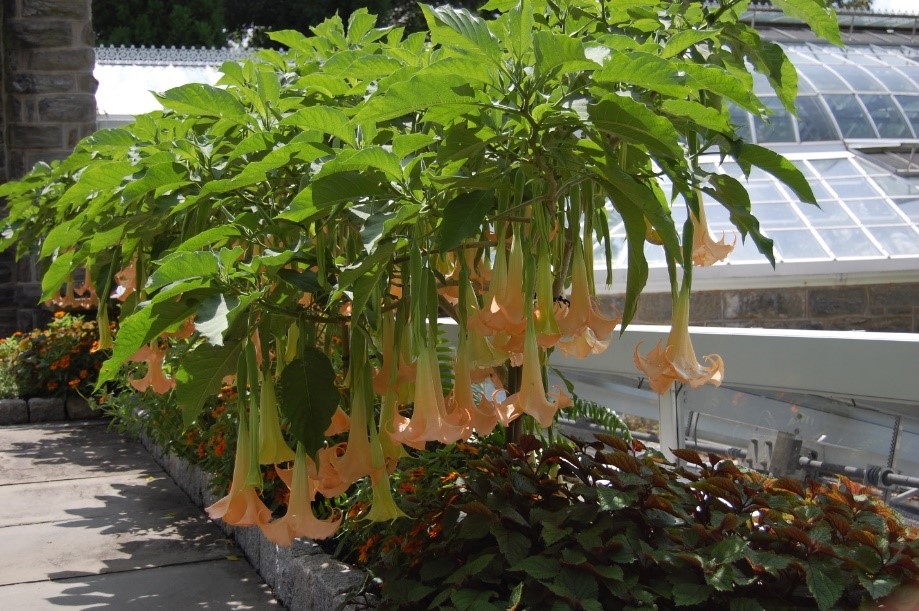
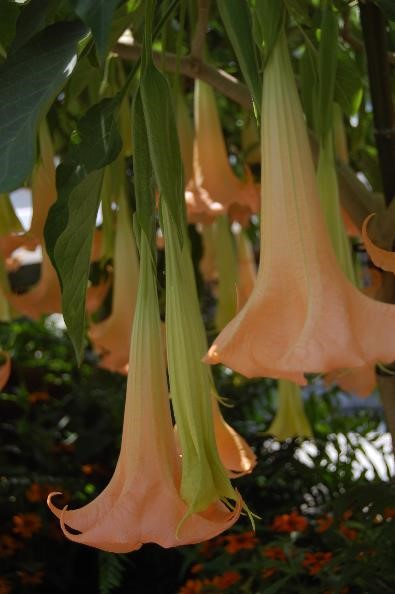
Brugmansia is closely related to another alkaloid bearing plant named Datura. In fact, Angels Trumpet was initially named Datura by the Swedish Botanist and Physician Carl Linnaeus (1707-1778) in 1753. It was not until 1805 that Christiaan Hendrik Persoon (1761-1836), who resided for most of his life in Paris and was most noted for his classification of mushrooms, properly classified this plant. The genus honors the Dutch botanist and physician Sebald Justin Brugmans (1763-1819). The common name of Angel’s Trumpet comes from the dangling, 6-10” long trumpet shaped flowers that resemble musical instruments pointed downward from Heaven (as seen above and at right). On the flipside Datura is often called Devil’s Trumpet since the 4-6” long flowers point upwards, resembling trumpets blaring up from the depths of the underworld. Clearly, Brugmansia received the more marketable name!

Aside from the orientation of the flower, there are numerous other differences. Unlike Datura, which consists of several herbaceous species reaching 4’ tall, Brugmansia species and hybrids are woody plants that have the potential to reach impressive heights of 10-30+ feet, depending upon the cultivar or species. The ovate foliage is arranged alternately and typically is lightly pubescent. For the selection ‘Snowbank’, the foliage is trimmed with a wide white border that nicely compliments the salmon flowers and has a far more robust border than the selection ‘Variegata’. The flowers have a lemony fragrance in the early evening to attract pollinating hawkmoths and bats, with the flower persisting for 2-6 days. The individual colors range from white to pink, yellow, orange and even maroon. The flowers typically appear in waves, separated by a 2-3 week rest period, allowing the plant to store up reserves for the next floral flush. By contrast, Datura features white or purple flushed flowers that occasionally appear as double. These flowers also open in the evening and are attractively fragrant.

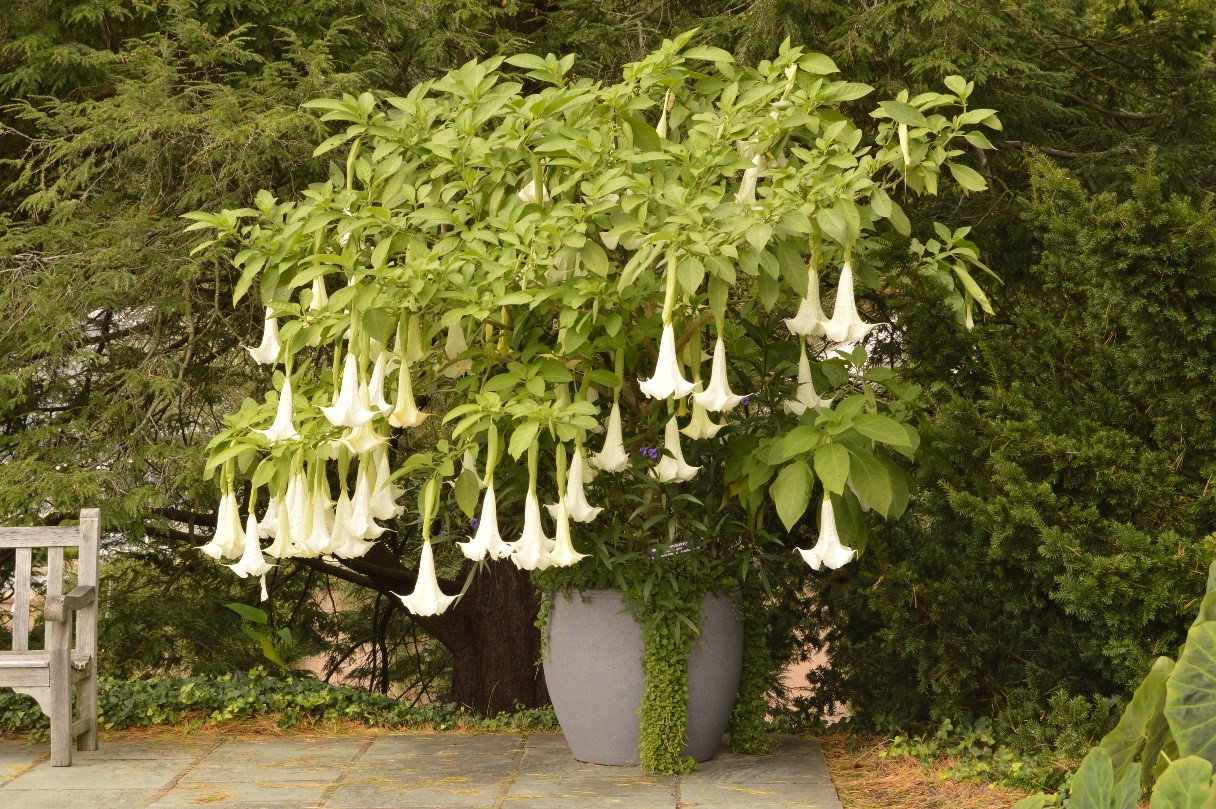
With its impressive size and relatively rapid rate of growth, it is no wonder that Brugmansia requires nutrient rich soils and sustained irrigation. Containers are a nice way to elevate and display the flowers on younger plants, since it brings the flower up to the gardeners and allows one to peer upwards into the flower (as seen below with ‘Cypress Gardens’ and below with ‘Frosty Pink’).

Brugmansia

When using containers, it is important to situate the plants in slightly larger containers, reducing the chance of the pot becoming root bound and drying out more rapidly. Flowering is greatly reduced should the plant experience drought! Container plants should also be on a weekly regiment of liquid fertilizer since slow release pellets do not provide a sufficient amount of nutrients for the plants. Locate Brugmansia in full sun for optimal growth, although light shade will also provide respectable results. If you are among those dedicated gardeners who wish to overwinter the plant, allow the plant to be defoliated by the first few autumn frosts before bringing the plant inside for the winter. Allowing the plant to become ‘frosted’ induces dormancy in the plant. It also results in the leaves dropping from the plant, which removes the food source for white fly, aphids, mealy bug and scale. Bring the plant indoors into a cool, dark location such as a basement, an attached but unheated garage or a cool closet and reduce the watering such that the soil remains only lightly moist. The lack of sunlight will aid in keeping the plant dormant and the dry soils will prevent root decay. Come spring, reintroduce the plant to light, prune off any dead wood, up-pot into a larger container and restart the fertilizing regiment!

Most of the plants available for the Garden are hybrids, rather than a species, which explains the obvious absence herein of species descriptions. Plants will also root fairly easily from cuttings, should a friend have a selection that you are envious of growing in your garden! Although far from dangerous in a garden display, care should be taken when handling cuttings. The Tropane Alkaloids mentioned earlier include strychnine, atropine and scopolamine, which in small quantities yield a numbing effect on the brain while larger quantities result in violent hallucinations and death. Obviously, great care and plastic/rubber gloves needs to be used while working with cuttings! Fortunately, the presence of the alkaloids does make the genus very resistant to deer browse.

A plant with great presence, intriguingly beautiful flowers and a sincere note of respect, Brugmansia has proven to be a wonderful plant for decorating the garden and wowing visitors. Should you be looking for a Tropical that provides the visual equal of horns sounding from the heavens above, this is the plant for you!

  • « Previous Page
  • 1
  • …
  • 24
  • 25
  • 26
  • 27
  • Next Page »

The Garden Club of New Jersey HQ

Garden Club of NJ Headquarters
Holly House – Rutgers University
126 Log Cabin Road
East Brunswick, NJ
Directions

Holly House Mailing Address:
126 Ryders Lane
East Brunswick, NJ 08816-1331
Office Telephone: (732) 249-0947

Facebook

STATEMENT OF GCNJ POLICIES

The EMBLEM of The Garden Club of New Jersey may not be used or copied in any way; by any club, individual, or for any purpose other than official application by the Executive Board of GCNJ. The EMBLEM of The Garden Club of New Jersey shall be used only on awards, publications, programs, etc. authorized by the Executive Board of GCNJ.

The NAME of The Garden Club of New Jersey shall not be used to endorse a candidate for office, product, lecture, tour or organization except as ordered by the Executive Board of GCNJ. The list of Executive Board members, Garden Clubs, their officers and members is not available for distribution to others except by special vote of the Executive Board of GCNJ.

(Do not post the Directory or its information on open websites.)

Copyright © 2026 · The Garden Club of New Jersey | All Rights Reserved | website design by DG design